

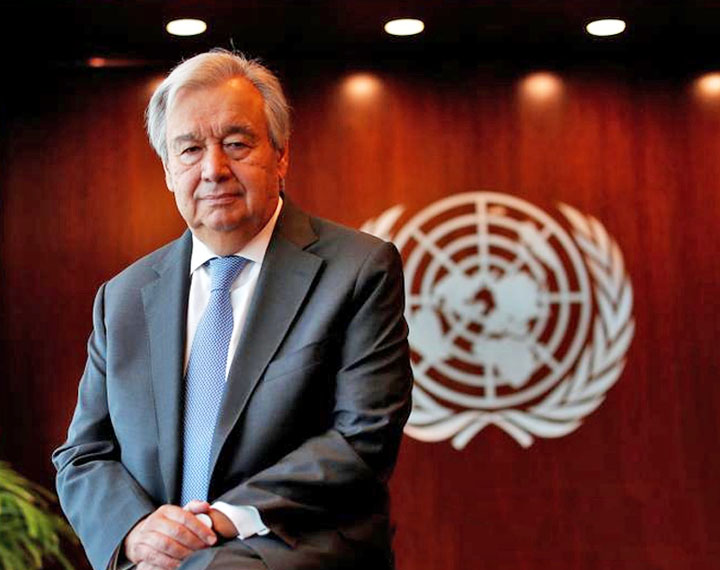
Despite our long list of global challenges, that same spirit of determination can guide us forward. Let us be determined to heal divisions and forge peace. Determined to uphold the dignity and worth of every person. Determined to realize the Sustainable Development Goals and leave no one behind. Determined to reform multilateralism for the 21st century and come together for the common good.
What an incredible journey of service and dedication! The life of His Excellency António Guterres is a powerful testament to the idea that with passion and perseverance, one person can make a profound difference in the world. His story is not just one of political ascent, but of a deep and unwavering commitment to human dignity, justice, and peace.
From a young age, António Guterres was driven by a desire to help others. He began his career not in politics, but in academia, teaching physics, while also volunteering in the slums of Lisbon. This hands-on experience with social inequality ignited a lifelong passion for public service. As he rose through the ranks of Portuguese politics, becoming Prime Minister in 1995, his focus remained on improving the lives of his fellow citizens, pushing for social reforms in education, healthcare, and welfare. He was also a passionate advocate for international cooperation, playing a key role in the resolution of the crisis in East Timor.
His most defining work, however, began in 2005 as the UN High Commissioner for Refugees. For a decade, he led one of the world’s most vital humanitarian organizations during a time of unprecedented displacement. He bore witness to immense suffering in refugee camps and war zones, and his experiences transformed him into a tireless advocate for the world’s most vulnerable. He championed bold reforms to make the UNHCR more efficient and responsive, fighting to protect those forced from their homes by conflict and persecution.
Since taking office as the ninth Secretary-General of the United Nations in 2017, António Guterres has centered his mission on one powerful phrase: “to serve as a peace broker, a bridge-builder, and a promoter of reform and innovation.”He has confronted some of the greatest challenges of our time head-on, from the climate emergency and growing global conflicts to inequality and the COVID-19 pandemic. His leadership is a masterclass in diplomacy, relentlessly urging nations to put aside their differences and work together for the common good.
His inspiring message is a constant reminder that we are all part of one global family, and our collective destiny depends on our ability to cooperate. He stands as a beacon of hope, proving that even in the face of daunting challenges, a commitment to kindness, empathy, and service can create a more just and peaceful world for generations to come.
The United Nations is an international organization founded in 1945. Currently made up of 193 Member States, the UN and its work are guided by the purposes and principles contained in its founding Charter. The UN has evolved over the years to keep pace with a rapidly changing world. But one thing has stayed the same: it remains the one place on Earth where all the world’s nations can gather together, discuss common problems, and find shared solutions that benefit all of humanity.
The United Nations stands as one of the most remarkable and inspiring achievements in human history, born from the ashes of global conflict with an audacious dream: to unite the world in a quest for peace, justice, and prosperity. Created in 1945 after the devastation of World War II, its founding charter was signed by 51 nations who vowed to prevent the recurrence of such a tragedy. The UN is not merely a collection of countries but a living testament to humanity’s capacity for cooperation, embodying the hopeful belief that nations can overcome their differences and work together for the common good.
The UN’s core mission is built on three pillars: maintaining international peace and security, protecting human rights, and promoting sustainable development. This mission is carried out by a vast and dedicated global family of agencies, funds, and programs that tackle every conceivable global challenge. From sending peacekeepers to conflict zones to providing life-saving humanitarian aid during disasters, the UN and its specialized agencies are often the first responders in times of crisis. They are on the front lines, quietly and effectively working to build stability, alleviate suffering, and offer a lifeline to millions.
Over its history, the UN has achieved monumental successes that have profoundly improved the human condition. It has played a pivotal role in ending colonialism, facilitating decolonization for more than 80 nations, and has been a relentless advocate for the dignity of every person through landmark declarations like the Universal Declaration of Human Rights. In the field of public health, agencies like the World Health Organization (WHO) have led global campaigns to eradicate diseases like smallpox and are at the forefront of the fight against modern pandemics. Perhaps its most ambitious and unifying project is the 2030 Agenda for Sustainable Development, which provides a universal blueprint for a better and more sustainable future for all. These goals—from ending poverty and hunger to combating climate change—are a powerful call to action, uniting governments, businesses, and individuals in a shared vision of progress.



 Own or work here?