

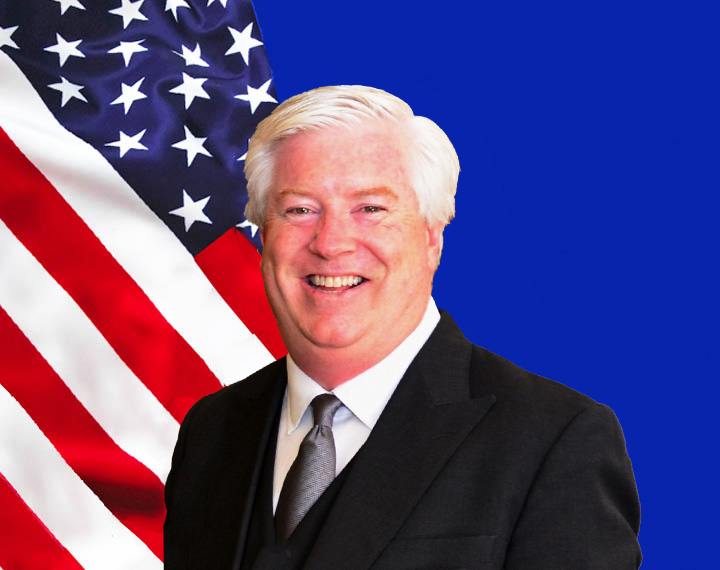
Ambassador George Edward Glass
Ambassador George Edward Glass is a distinguished American diplomat, entrepreneur, and public servant whose life and career reflect a deep belief in leadership through service, diplomacy through respect, and progress through partnership. Appointed as the United States Ambassador to Japan in April 2025, Ambassador Glass brings to Tokyo a wealth of global experience, business acumen, and an unwavering commitment to strengthening the enduring bond between the United States and Japan.
Born in Oregon, Ambassador Glass built his early career in the private sector, where he founded and led a highly successful investment and financial services firm. His work in international business cultivated a global perspective rooted in mutual understanding, integrity, and innovation. Guided by a strong sense of civic duty, he later transitioned into public service — serving as U.S. Ambassador to Portugal from 2017 to 2021, where he played a vital role in advancing transatlantic cooperation, economic growth, and cultural exchange.
Known for his inclusive leadership and forward-looking diplomacy, Ambassador Glass embodies the ideals of American engagement abroad: partnership, transparency, and shared prosperity. His vision as Ambassador to Japan focuses on deepening collaboration in key areas such as technology, defense, clean energy, and cultural exchange — ensuring that the U.S.–Japan alliance remains a cornerstone of peace and stability in the Indo-Pacific region.
Respected for his humility and dedication, Ambassador Glass has consistently emphasized that true diplomacy begins with listening and mutual respect. His approach bridges the best of two nations — the American spirit of innovation and the Japanese values of harmony and perseverance — creating a partnership built on trust, respect, and common purpose.
With a steady hand, a compassionate heart, and a lifelong belief in the power of dialogue, Ambassador George Edward Glass stands as a symbol of inspired leadership — one who reminds the world that diplomacy, at its best, is not about power or position, but about people, peace, and progress shared across generations and borders.
The Embassy of the United States in Tokyo represents the United States in Tokyo, Japan. Along with consulates in Osaka, Nagoya, Sapporo, Fukuoka, and Naha, the Embassy provides assistance to American citizens and residents who live in Japan and issues visas to Japanese nationals, and legal residents in Japan who wish to visit or immigrate to the United States.
To maintain relations with other countries and international organizations, the United States has embassies and consulates around the world. Under the direction of the president, the Secretary of State is responsible for the overall coordination and oversight of activities of the US government in foreign countries. Representatives of overseas diplomatic representatives residing in various countries and overseas diplomatic representatives living in international organizations are ambassadors. The ambassador is regarded as the President ‘s personal representative, and with the Secretary of State, it supports the president’ s responsibilities under the Constitution in US diplomatic activities.
Staff are dispatched from other administrative agencies to most foreign diplomatic missions other than the State Department staff. Depending on overseas diplomatic establishments, the number of State Department staff is less than half. The State Department officials working at overseas diplomatic missions have government appointees, professional diplomats, and local staff who are based in the United States. The local officials are residents of the local people who are familiar with local languages and cultures and instead of American employees who are constantly changing, keep the continuity of the functions of the embassy. Some local staff are employed by other administrative organs.
Other administrative organizations that have representatives in overseas diplomatic missions include the Ministry of Commerce, Ministry of Agriculture, Department of Defense, Department of Justice (Immigration Naturalization Bureau, Drug Enforcement Bureau, Federal Bureau of Investigation) and the International Development Agency. Other administrative agencies also play an important role in leading the United States’ diplomatic activities to success and promoting the national interests of the United States.



 Own or work here?