

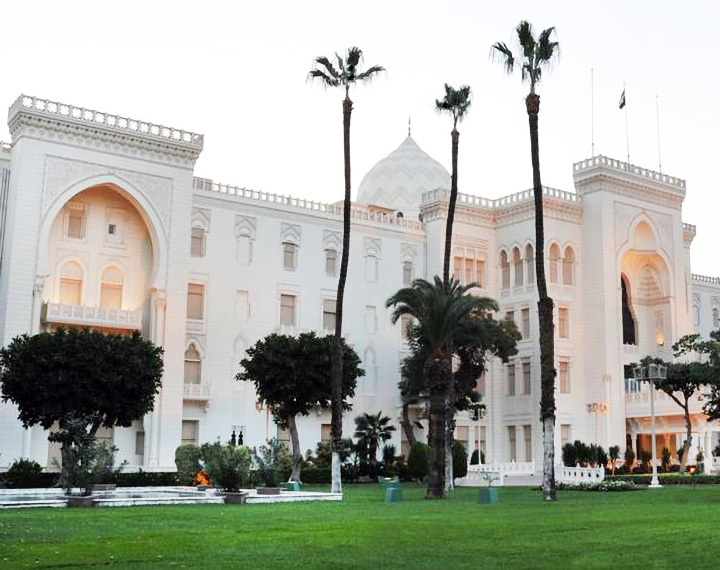
Al Ittihadiya Palace, also known as Heliopolis Palace or Al-Orouba Palace, stands as a magnificent landmark in the upscale Heliopolis district of Cairo, Egypt. Originally constructed between 1908 and 1910 as the luxurious Heliopolis Palace Hotel, it was one of the most opulent hotels in Africa at the time. Designed by Belgian architect Ernest Jaspar with contributions from others, the palace showcases a stunning blend of Islamic, Moorish Revival, Persian, and European architectural styles, featuring intricate details, a prominent 55-meter-high dome, and lavish interiors adorned with marble columns, crystal chandeliers, and oriental carpets.
Over the decades, the palace underwent significant transformations. After serving as a hotel and later a military hospital during World War I, it was nationalized and used for various government purposes. In 1972, during President Anwar Sadat’s era, it became the headquarters of the Federation of Arab Republics, earning its current name “Al Ittihadiya,” meaning Federation Palace. A major restoration in the 1980s preserved its heritage, after which it was designated as the primary workplace for the Egyptian Presidency, where the President receives official delegations and conducts state affairs.
Surrounded by lush gardens that provide a serene contrast to the bustling city, Al Ittihadiya Palace remains an active symbol of Egypt’s modern governance while embodying its rich historical legacy. Its grand halls and elegant facade continue to host important national and international events, reflecting both the country’s architectural brilliance and its evolving political history. The palace is one of several presidential residences in Egypt, distinguished by its unique origins as a desert oasis hotel envisioned by Baron Édouard Empain.



 Own or work here?