

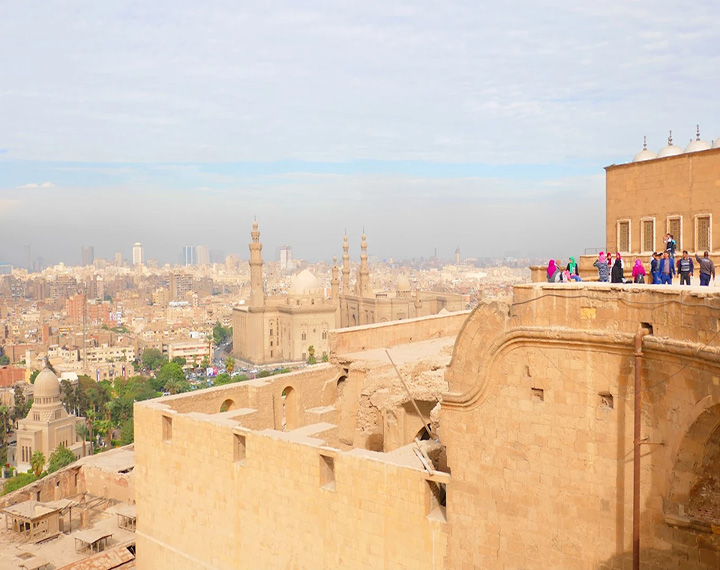
The Ablaq Palace, known in Arabic as Qasr al-Ablaq, stands as one of the most storied lost treasures of the Cairo Citadel, representing the height of 14th-century architectural sophistication. Commissioned by the prolific Mamluk Sultan al-Nasir Muhammad in 1313, the palace derived its name from the striking “ablaq” masonry—a technique featuring alternating rows of light limestone and dark basalt that created a bold, striped exterior. Positioned on the western escarpment of the Southern Enclosure, the palace was designed to be both a private sanctuary for the Sultan and a grand administrative hub where he held daily audiences and conducted the vital affairs of the state.
While much of the original structure was tragically demolished in the 19th century by Muhammad Ali Pasha to make way for his famous Alabaster Mosque, the historical descriptions of its interior evoke a world of unparalleled opulence. Chronicles detail a palace adorned with shimmering marble floors, gold-paneled walls, and vibrant glass windows imported from Cyprus. The ceilings were reportedly gilded and painted in a deep lapis lazuli blue, while intricate floral mosaics crafted from mother-of-pearl decorated the reception halls. Today, only selective foundations and a set of massive stone corbels remain, serving as hauntingly beautiful reminders of a palace that once rivaled the finest royal residences in the medieval world.
Culturally, the Ablaq Palace was a pioneer of the “qa’a” layout, featuring two unequal vaulted chambers known as iwans facing a central domed courtyard. The northwestern iwan was particularly famous for its panoramic loggia, which allowed the Sultan to gaze out over the imperial stables, the bustling horse bazaar, and the vast urban sprawl stretching from the Nile to the Pyramids of Giza. This strategic design reflected the Sultan’s desire to remain connected to the life of his city while maintaining the lofty isolation of his royal status. The palace later transitioned into a factory for the Kiswa—the sacred cloth of the Ka’ba—during the Ottoman era, further cementing its historical importance.
Tourists visiting the Saladin Citadel today can explore the archaeological site near the Mosque of Sultan al-Nasir Muhammad, where the palace’s footprint provides an informative window into the Mamluk legacy. Walking through the ruins offers an inspiring perspective on the scale of medieval Egyptian engineering and the artistic cross-pollination between Persian, Syrian, and Egyptian craftsmen. The site remains a focal point for those seeking to understand the layered history of Cairo, where the remnants of the Striped Palace sit silently beneath the shadow of the more modern monuments that replaced it, symbolizing the eternal cycle of renewal in one of the world’s oldest capitals.
The spirit of the Ablaq Palace continues to motivate historians and architects who study the “ablaq” style as a hallmark of Islamic decorative art. Even in its ruined state, the site radiates an uplifting sense of grandeur, encouraging visitors to imagine the vibrant ceremonies and royal processions that once filled its courtyards. It is a place where the physical stones tell a story of ambition and aesthetic brilliance, ensuring that the name of al-Nasir Muhammad remains synonymous with the golden age of Cairo’s architectural heritage. For any traveler exploring the heights of the Citadel, the ruins of this striped marvel are an essential stop for a deeper connection to Egypt’s regal past.



 Own or work here?