


A Royal Homecoming: King Charles III and Queen Camilla’s Three-Day Visit to Northern Ireland
A Visit Rooted in Friendship, Culture, and Community
In a moment that will be written into the history of Northern Ireland with pride and with warmth, King Charles III and Queen Camilla arrived in Belfast on Tuesday, the 19th of May 2026 — bringing with them the full grace and purpose of the Crown, and a genuine desire to celebrate the extraordinary people of this remarkable land. The three-day tour that followed would prove to be one of the most warmly received royal visits in living memory, animated by a singular and deeply purposeful spirit: to celebrate the living culture of the region, to engage with its extraordinary communities, and to affirm the enduring relationship between the Crown and the people of Northern Ireland. 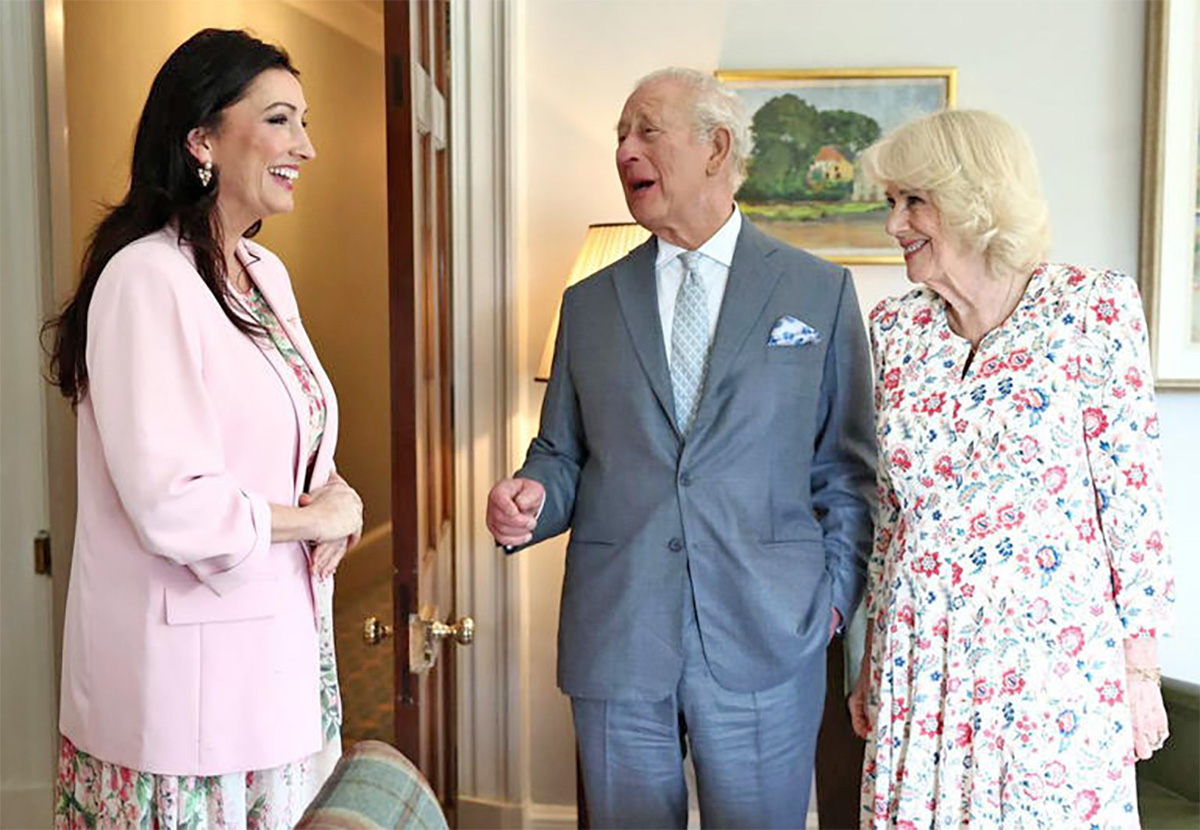 At its heart lay a cause of profound cultural significance — Belfast was preparing to host, for the very first time, the Fleadh Cheoil na hÉireann, the world’s largest celebration of traditional Irish music, song, and dance, due to take place that August. The key stakeholders who shaped the spirit of the tour were the people of Northern Ireland themselves — schoolchildren, community volunteers, local business owners, artists, gardeners, and musicians — together with First Minister Michelle O’Neill and Deputy First Minister Emma Little-Pengelly, both of whom extended the warmest of official welcomes to Their Majesties and received the royal couple at the historic Hillsborough Castle, the official royal residence in Northern Ireland. It was a tour not of ceremony alone, but of genuine, joyful, and lasting human connection.
 Day One, May 19 — Thompson Dock and the Titanic Quarter: Where History Meets Melody
The royal couple began their visit at Thompson Dock, one of Belfast’s most celebrated landmarks — the very last place the Titanic stood on dry ground before her ill-fated maiden voyage in 1912, built at the legendary Harland and Wolff shipyard in the heart of the city. It was a setting of extraordinary historical resonance, and the atmosphere crackled with anticipation. Braving the rain and the unseasonal spring temperatures, the King and Queen joined a vibrant gathering of musicians, dancers, and performers assembled to mark the forthcoming Fleadh, meeting its organisers and the volunteers preparing to make the summer festival a landmark occasion for the whole island of Ireland.
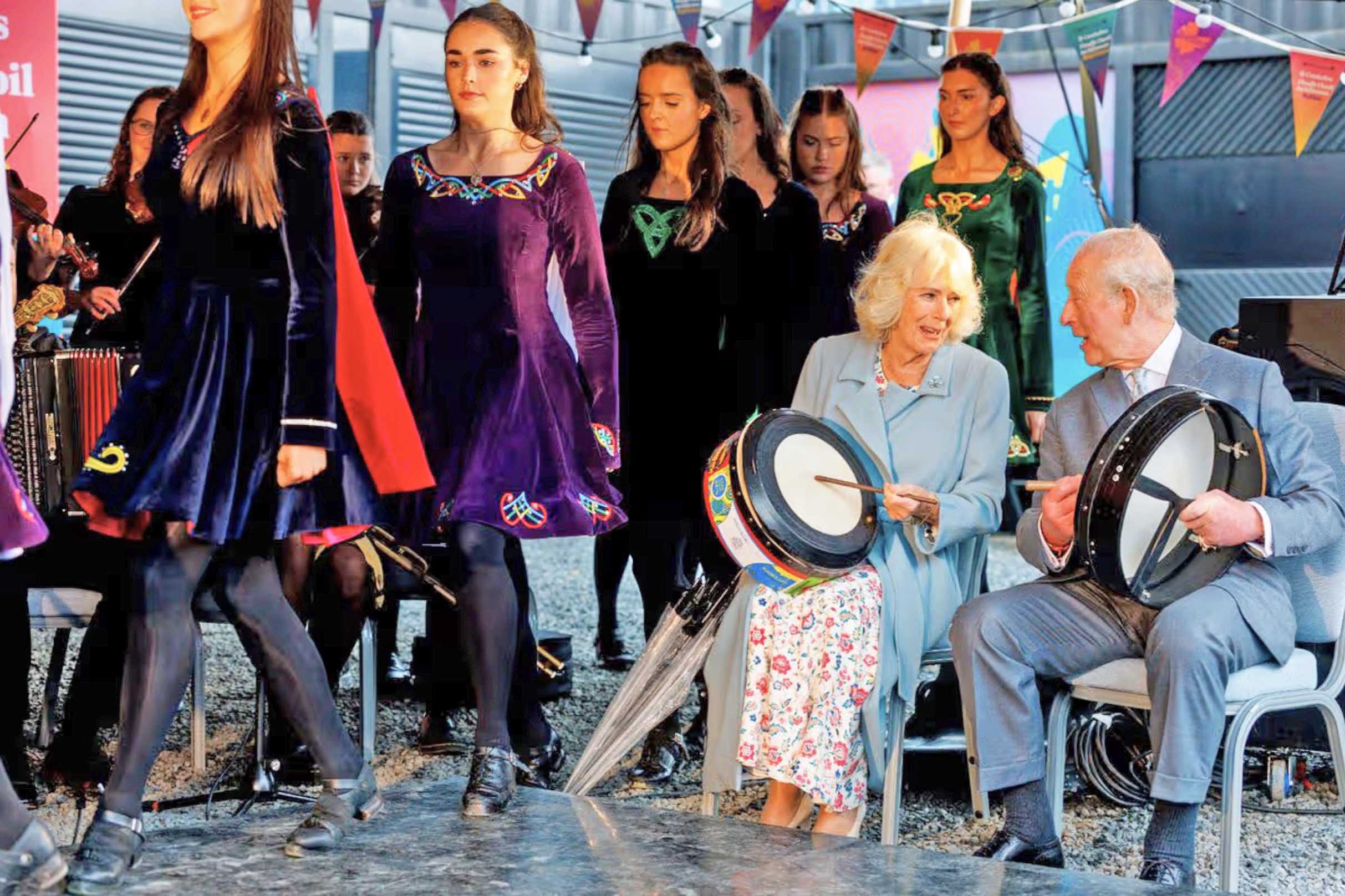
What followed was one of the most joyful and talked-about images of the entire royal tour. Both King Charles and Queen Camilla took up traditional Irish bodhrán drums and began to play — the ancient hand drum whose deep, resonant pulse has driven the heartbeat of Irish traditional music for generations. Seated among the performers, the royal couple leant into the rhythm with evident pleasure and natural ease, the King tapping the skin of the drum with genuine enthusiasm whilst the Queen watched the dancers swirl before them, her own hand moving in time. It was an image of spontaneous, unguarded joy — a King and Queen not presiding over a performance, but joining one. The crowd erupted in delight.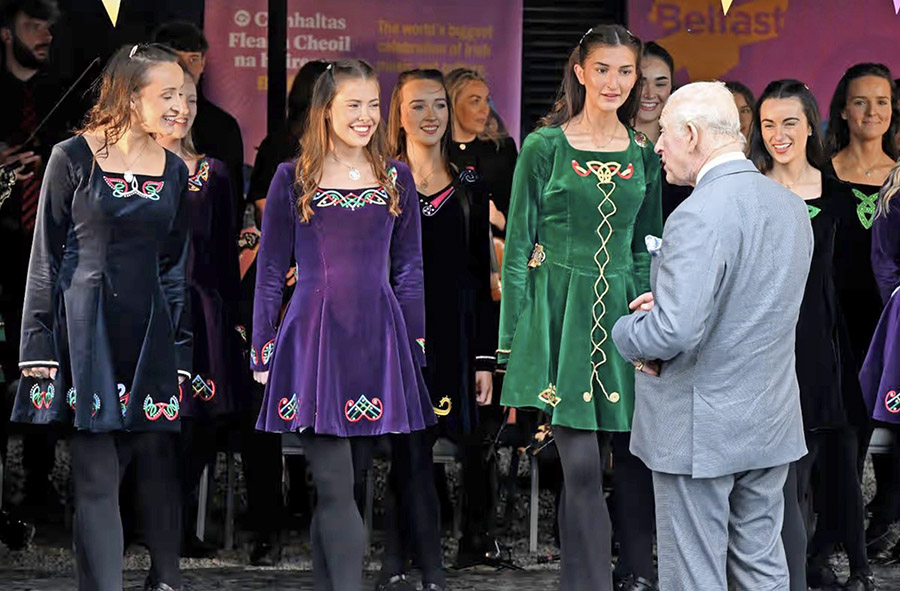
Pausing from the drums, the King made his way towards a group of Irish dancers who had performed with remarkable grace and energy throughout the afternoon. He stopped to chat with them, asking about their training, their love of the dance, and their excitement at the forthcoming Fleadh. The young dancers, their eyes bright and their cheeks flushed with the thrill of the moment, were visibly overjoyed to have met their King. Several spoke afterwards of the encounter with barely contained delight — one young dancer describing it as the most memorable day of her life, whilst another said simply that the King had made them all feel so special, so seen, and so proud of the tradition they carried.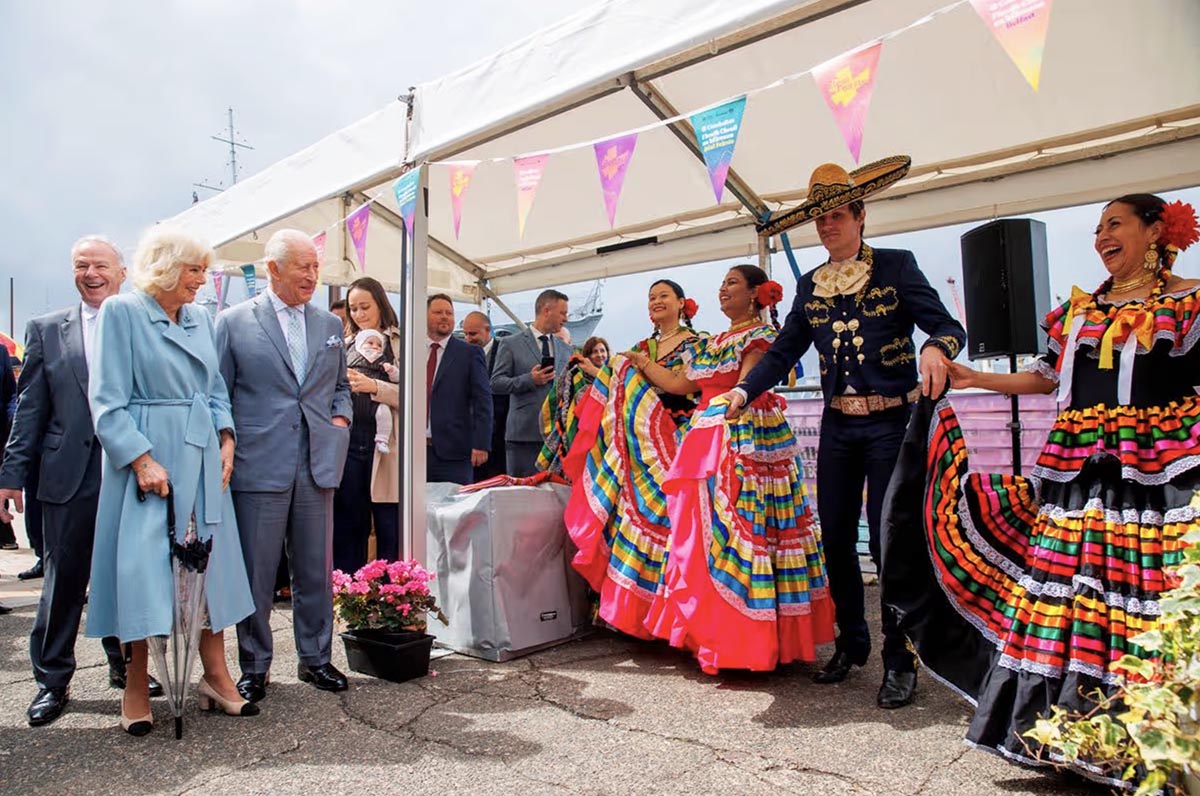
Among the most visually breathtaking moments of the afternoon came when members of Belfast’s Mexican community took to the performance space in a dazzling display of colour, movement, and cultural pride. The King and Queen watched with evident fascination and delight as the dancers moved with extraordinary precision and grace, their traditional dress a magnificent spectacle — vivid embroidered skirts in scarlet, emerald, and gold catching the light as they spun, the richly decorated blouses and boldly patterned shawls reflecting centuries of Mexican artistry and heritage. It was a performance of remarkable beauty, and the royal couple’s appreciation was clear and unfeigned, both leaning forward with wide smiles as the dancers wove their patterns across the floor. That such a scene could unfold on the Belfast waterfront — Mexican tradition alive and magnificent in the shadow of the Titanic Quarter — spoke profoundly to the remarkable diversity and openness of the Northern Ireland of today.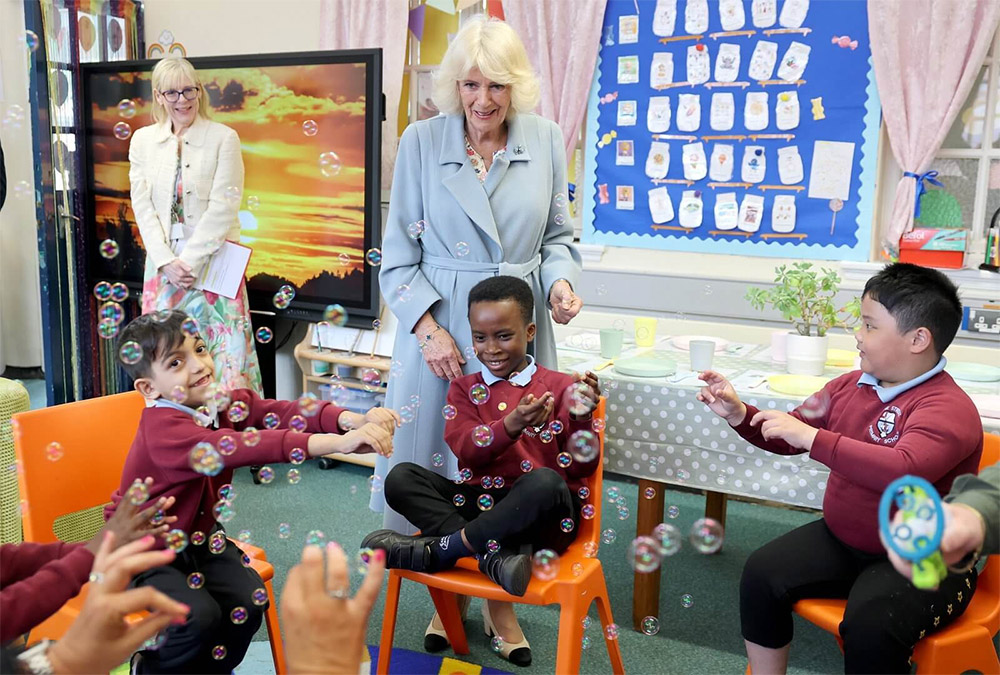
School children played Irish folk songs on penny whistles, banjos, and guitars; jugglers wove through the gathering; and performers in national dress from countries as varied as Poland, Malawi, East Timor, and China added their own vivid threads to an afternoon that felt, above all else, like a celebration of humanity in all its beautiful variety. It was Northern Ireland at its most joyfully, gloriously diverse — and at the centre of it all, two royals playing Irish drums in the rain, smiling broadly, and entirely present.
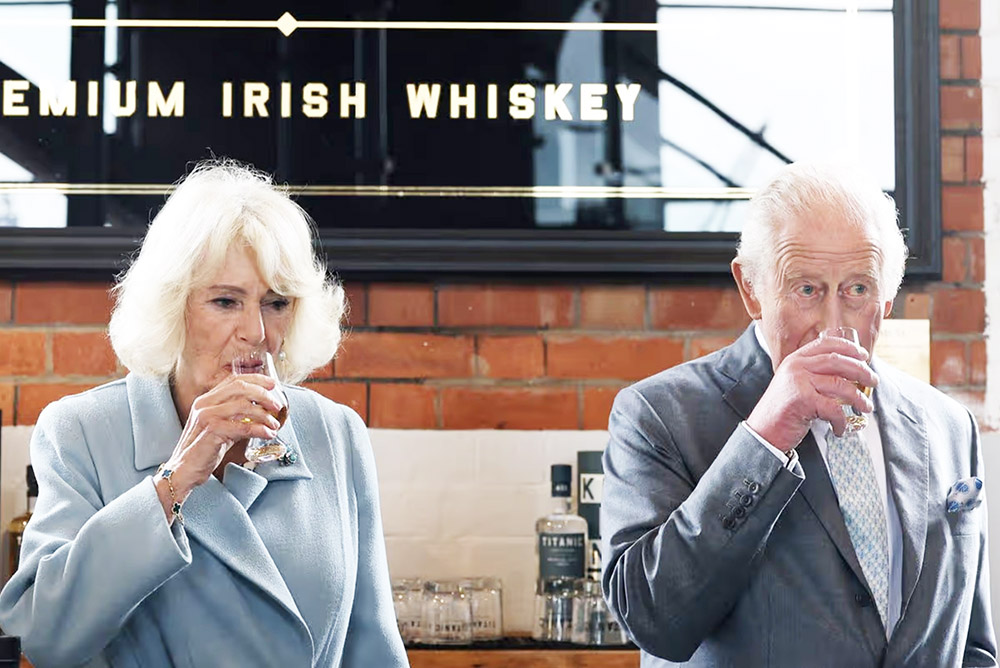
From Thompson Dock, the royal couple moved to Titanic Distillers, housed within the beautifully restored Edwardian pumphouse that once helped prepare the great ship for her voyage. There they met distillery staff, learnt about the whisky-making process, and sampled some of the fine spirit produced within those historic walls. King Charles then joined young people and business owners at the Odyssey Complex to mark the 50th anniversary of The King’s Trust, and watched with obvious delight as students from Strabane Academy demonstrated their robotics projects. Meanwhile, across the city in south Belfast, Queen Camilla made her way to Fane Street Primary School — a place whose pupils had written to her months earlier, filling her correspondence with handmade letters and heartfelt invitations. The school is a remarkable community of 285 children representing 45 countries and speaking 47 different languages, a living portrait of modern Northern Ireland at its most extraordinary. The Queen was treated to a musical and dance performance in the assembly hall before unveiling a commemorative plaque and presenting a selection of children’s books to the school.
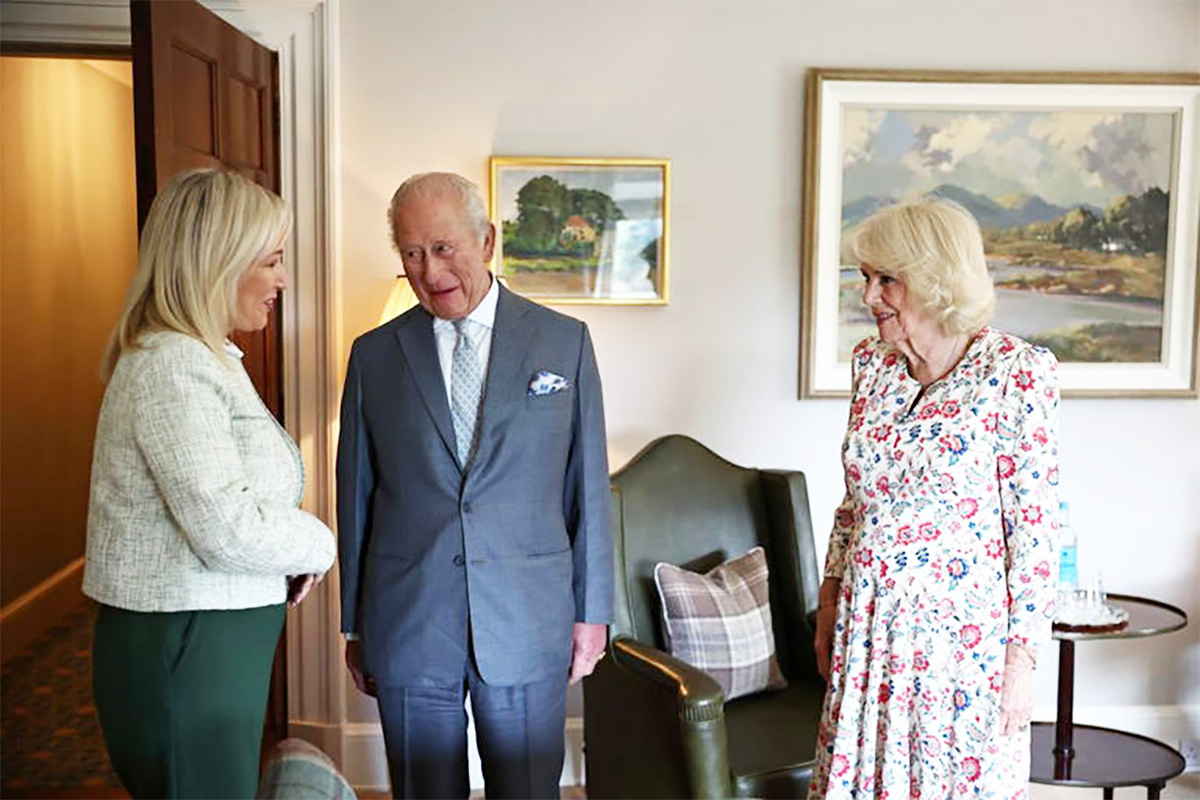
The day drew to a dignified and warmly symbolic close at Hillsborough Castle, where, following their afternoon engagements, the King and Queen sat down for a formal meeting with First Minister Michelle O’Neill and Deputy First Minister Emma Little-Pengelly. The King greeted Mrs O’Neill with a firm and cordial handshake before turning to share a moment of easy laughter with Mrs Little-Pengelly — the kind of unscripted warmth that speaks more eloquently than any prepared address. The four sat together within the historic walls of the castle, and the conversation that followed was marked by the spirit of mutual respect and shared goodwill that has come to define the relationship between the Crown and Northern Ireland’s political leadership. Deputy First Minister Little-Pengelly, clearly moved by the occasion, later took to social media to share her welcome, posting a photograph of herself seated with the King at the castle. Her caption captured the feeling of the day with graceful simplicity: “It is wonderful to have Their Majesties in Northern Ireland for a Royal Visit and to have the opportunity for a conversation with His Majesty, The King and to meet with Her Majesty, The Queen.” For the occasion, Queen Camilla had worn a long-sleeved floral dress by Fiona Clare beneath a beautifully cut blue wool coat by Anna Valentine — effortlessly elegant against the timeless grandeur of Hillsborough Castle.
 Day Two, May 20 — Newcastle and Royal Hillsborough: The King and Queen Go Their Own Way
If the first day had been a celebration of culture and creativity on the grand Belfast stage, the second day brought something altogether more intimate — a series of encounters rooted in the everyday lives of the people of County Down, and all the richer and more moving for it. The King and Queen set out on separate paths through the county, each finding in their own engagements a warmth and generosity of spirit that would remain long in the memory.
King Charles travelled to Newcastle, where his first visit was to The Pantry Foodbank at Donard Methodist Church — a community lifeline staffed entirely by the kind of quietly dedicated volunteers whose generosity of spirit is the very foundation upon which a compassionate society is built. The King moved through the foodbank with genuine interest and evident admiration, pausing to speak with the volunteers who give their time so wholeheartedly and to hear the stories of those whose lives the pantry has so meaningfully supported.
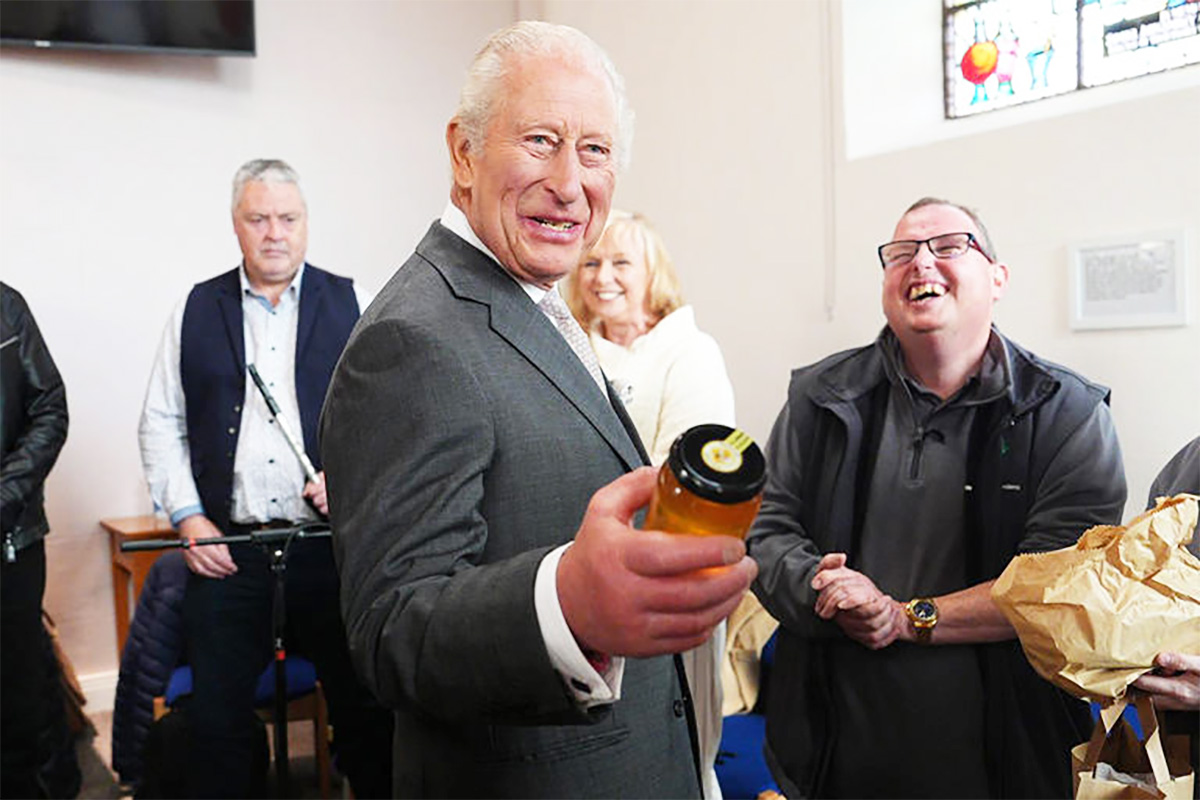
The visit produced two of the most warmly human and utterly charming moments of the entire tour. The King was presented with a jar of locally produced honey — a gift offered with such simple sincerity that it seemed to encapsulate, in a single gesture, the generosity and warmth of the people of Newcastle. His Majesty received it with evident delight, turning the jar in his hands with the appreciation of a man who understands and treasures the extraordinary labour that lies behind every drop. And then, in a moment that brought smiles to every face in the room, the King was offered a loaf of freshly baked local wheaten bread — that most beloved of Northern Irish traditions — and brought it to his nose with the unaffected curiosity of someone who finds genuine pleasure in the sensory riches of the world around him. The warm, wholesome scent of the bread clearly met with royal approval, and the laughter that followed was as natural and as unrehearsed as anything in the entire three days.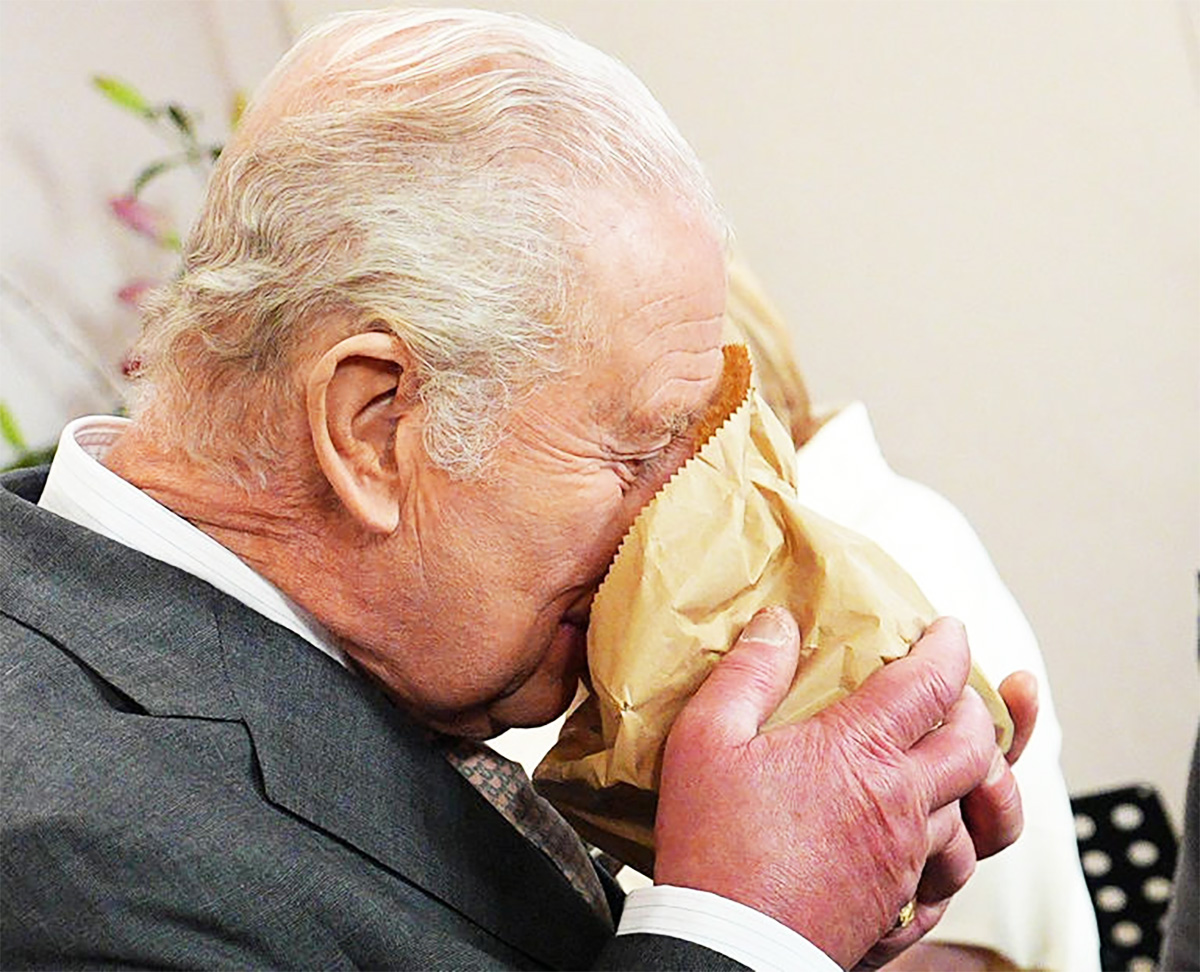
He then met representatives of the local RNLI and Mountain Rescue teams before stepping out into the streets for a public walkabout that became one of the most emotionally resonant moments of the entire tour. The crowds called out his name with unscripted affection, and the words that reached him were simple, sincere, and unforgettable. Among those lining the route was Rosemary Allan, on the eve of her 102nd birthday, and eleven-year-old schoolboy George Murdoch, who had arrived bearing a box of freshly-laid eggs as a gift for his King. One voice in the crowd declared: “Welcome to Northern Ireland, Your Majesty, thank you for coming to see us.” Another rang out with: “We love you, Charles.” A third, deeply moved, said simply: “This is so special. I will never forget it.”
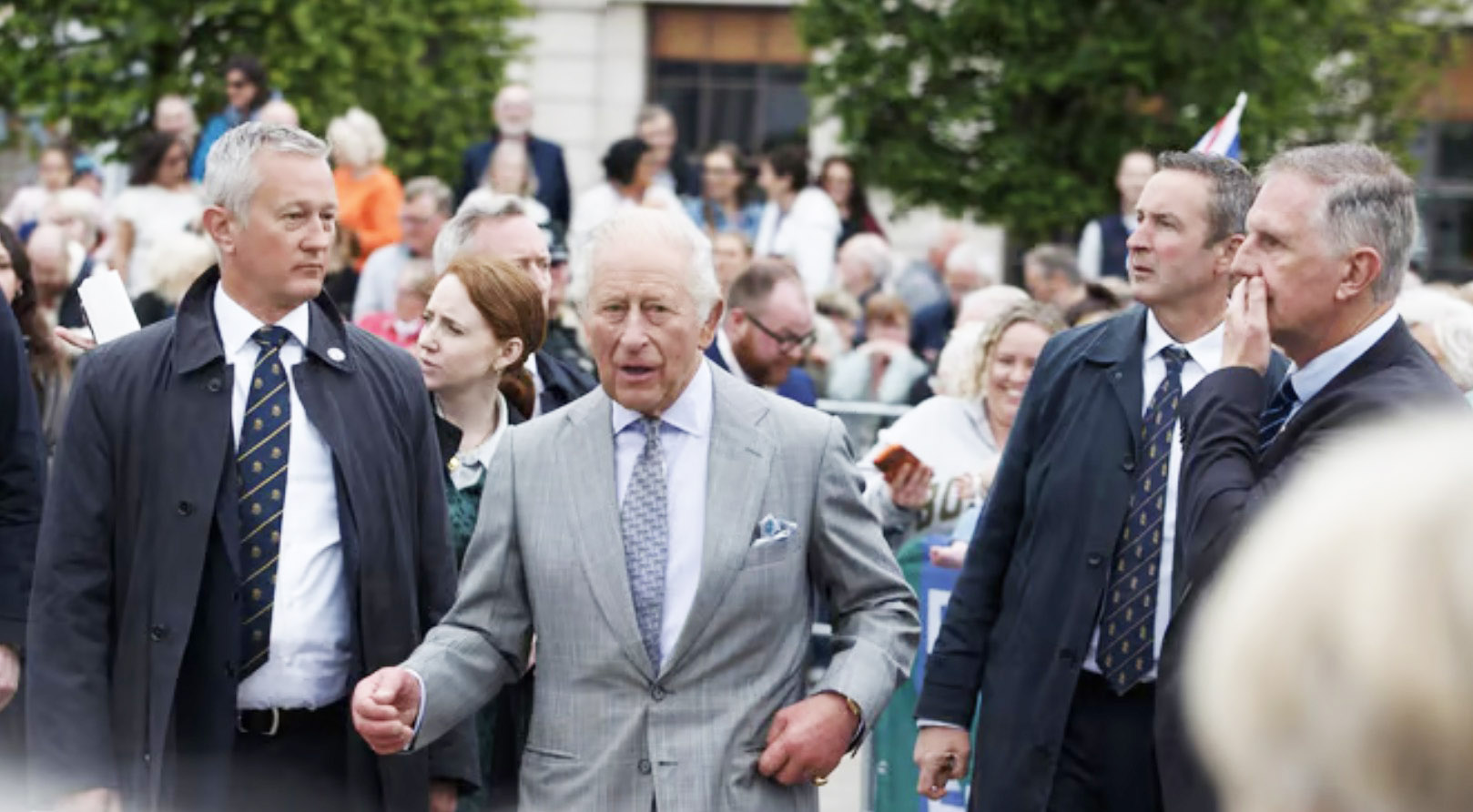
It was during this walkabout that one of the most talked-about moments of the tour took shape — not in a grand hall or a formal reception, but on a pavement in Newcastle, under an open sky. A seagull, entirely indifferent to the dignity of the occasion, left its mark on the back of the King’s jacket. His Majesty laughed it off with the easy, unaffected good grace that has come to define his public character, turning the moment into a shared joke with the delighted crowd around him. It was, in its own way, the most human moment of the visit — and it brought the house down.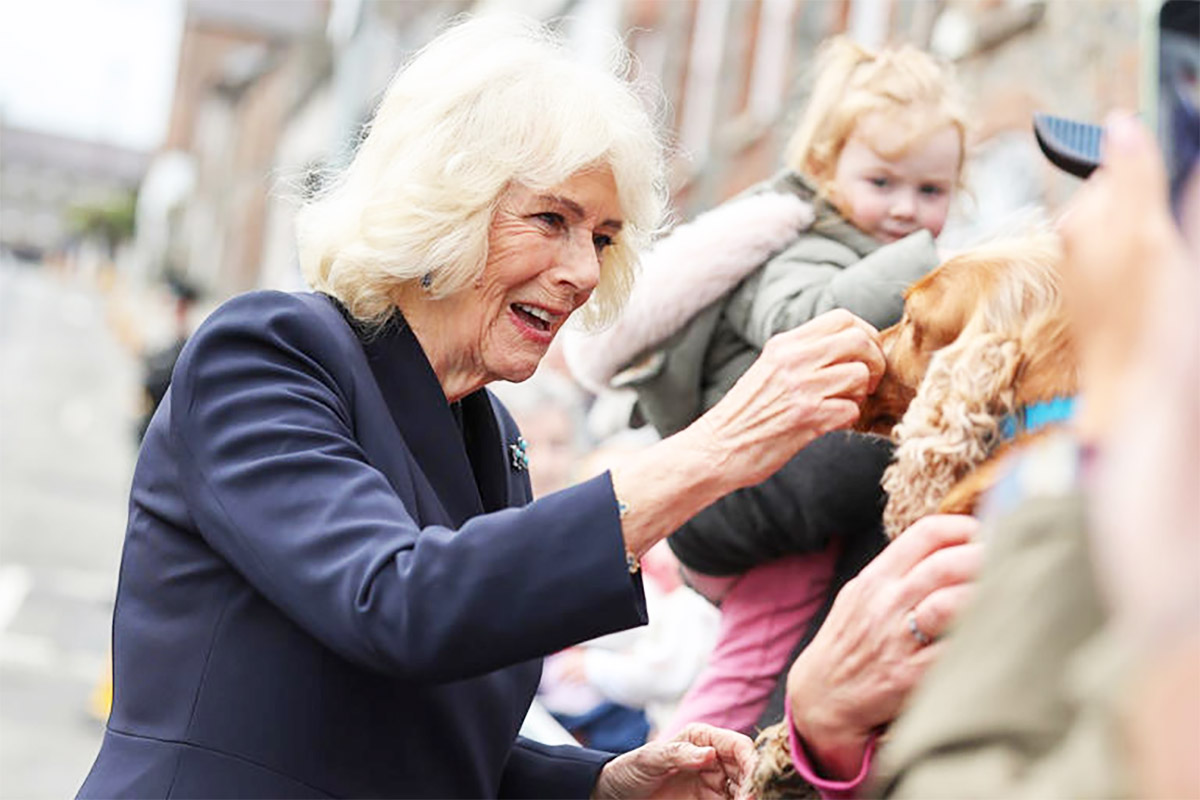
Across County Down, Queen Camilla made her way to Royal Hillsborough — the first village in the nation to be awarded Royal status, an honour bestowed in 2021 — conducting her own engagements with equal warmth and characteristic style. She looked radiant in a navy feather-print dress by Fiona Clare paired with a matching coat by The Fold, moving through the charming village streets with the ease of someone entirely at home among the people she was there to meet. It was along these same warm and welcoming streets that one of the most endearing and naturally joyful moments of the entire tour unfolded — for as the Queen made her way through the gathered well-wishers of Hillsborough, she paused to greet a dog being walked by its proud owner in the crowd. A devoted animal lover of long standing, Queen Camilla crouched with characteristic unselfconsciousness to pet the delighted creature, her face lighting up with the kind of pure, unguarded pleasure that only the company of a dog can produce. The watching crowd melted entirely — laughing, cheering, and capturing the moment with raised phones — as their Queen lavished her full attention on the newest and perhaps most enthusiastic royal acquaintance of the tour. It was a moment of such simple, spontaneous warmth that it seemed to capture something essential about the Queen herself: a woman of great elegance and quiet distinction, who will always, without hesitation, stop to make a fuss of a dog.
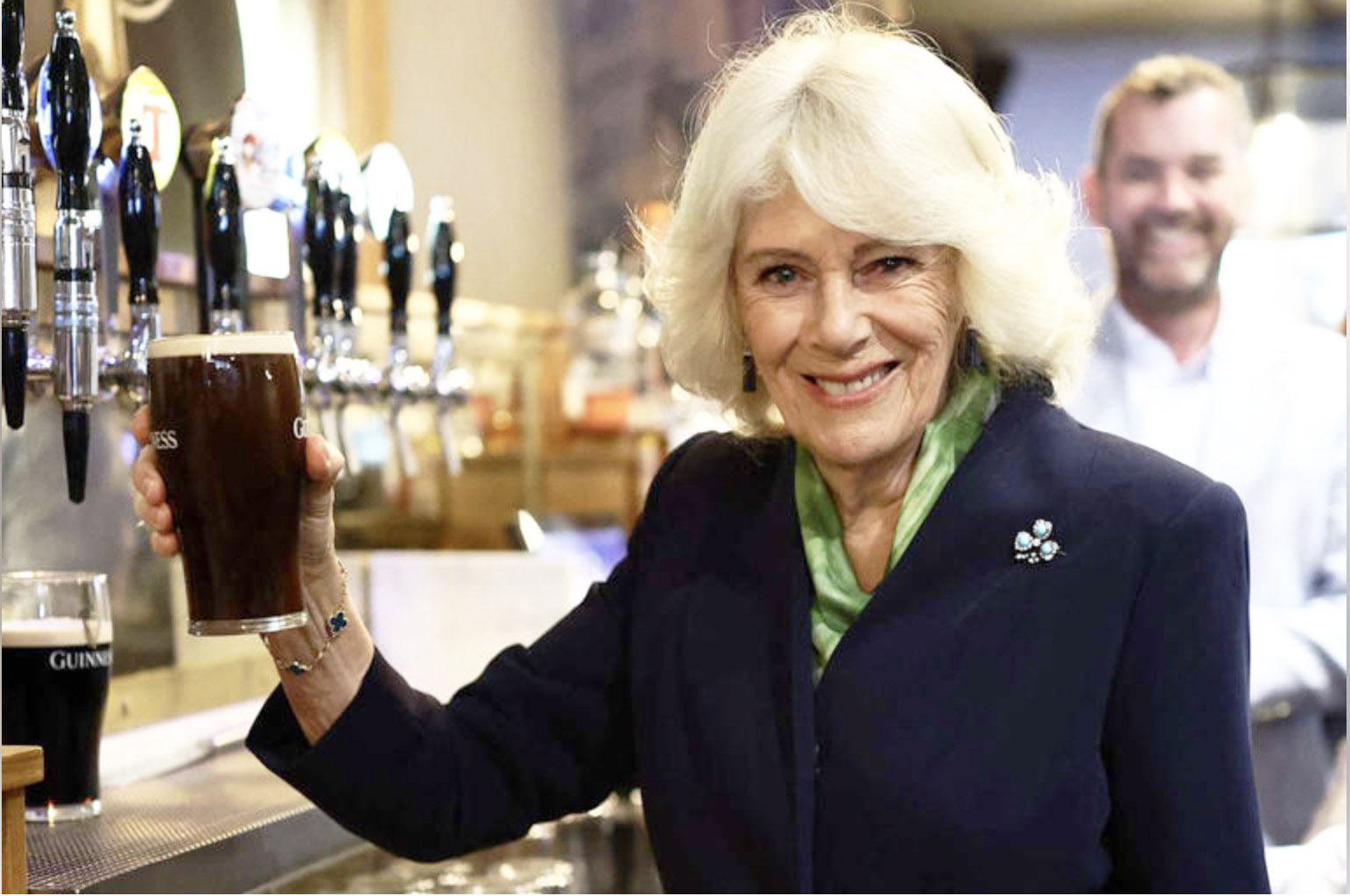
Her first formal port of call was The Parson’s Nose, the much-loved pub and restaurant at the heart of village life in Hillsborough, where she was welcomed by staff with tremendous warmth and genuine delight. After being introduced to the managers, chefs, and waitresses who give the establishment its celebrated character, the Queen was invited to pour a pint of Guinness — and she accepted the challenge with the smile of someone who had every intention of rising to the occasion. Standing at the bar with quiet concentration, Queen Camilla drew the pint with admirable care and patience, tilting the glass just so as the dark liquid settled into its creamy perfection. When she held up her self-poured glass for all to see, the room erupted in a spontaneous and thoroughly heartfelt round of applause. Beaming with evident satisfaction, the Queen remarked with characteristic wit that she was “not quite the expert, but my husband is” — before adding, with a glint of mischief, that it was “a bit early to drink” and that she would leave the magnificent pint waiting for later. The room rang with warm, genuine laughter, and word of the Queen’s flawlessly poured Guinness spread through Hillsborough with the speed and delight that only the most perfectly judged royal moments can inspire. The Queen expressed her amazement at the number of wonderful local businesses concentrated in such a compact and beautiful village, sharing her delight at finally making the visit after spending so much time just up the road at the castle.
Later in the afternoon, the King and Queen reunited at Hillsborough Castle for a garden party on the grounds — a moment of shared joy after a day of separate but equally remarkable engagements. Side by side once more, they moved among the guests with the ease and warmth of two people entirely united in their purpose and their pleasure, before together planting a Malus Royalty tree in the castle grounds — a living, rooted symbol of everything the day had represented: growth, continuity, and the deep and enduring bond between the Crown and the people of Northern Ireland.
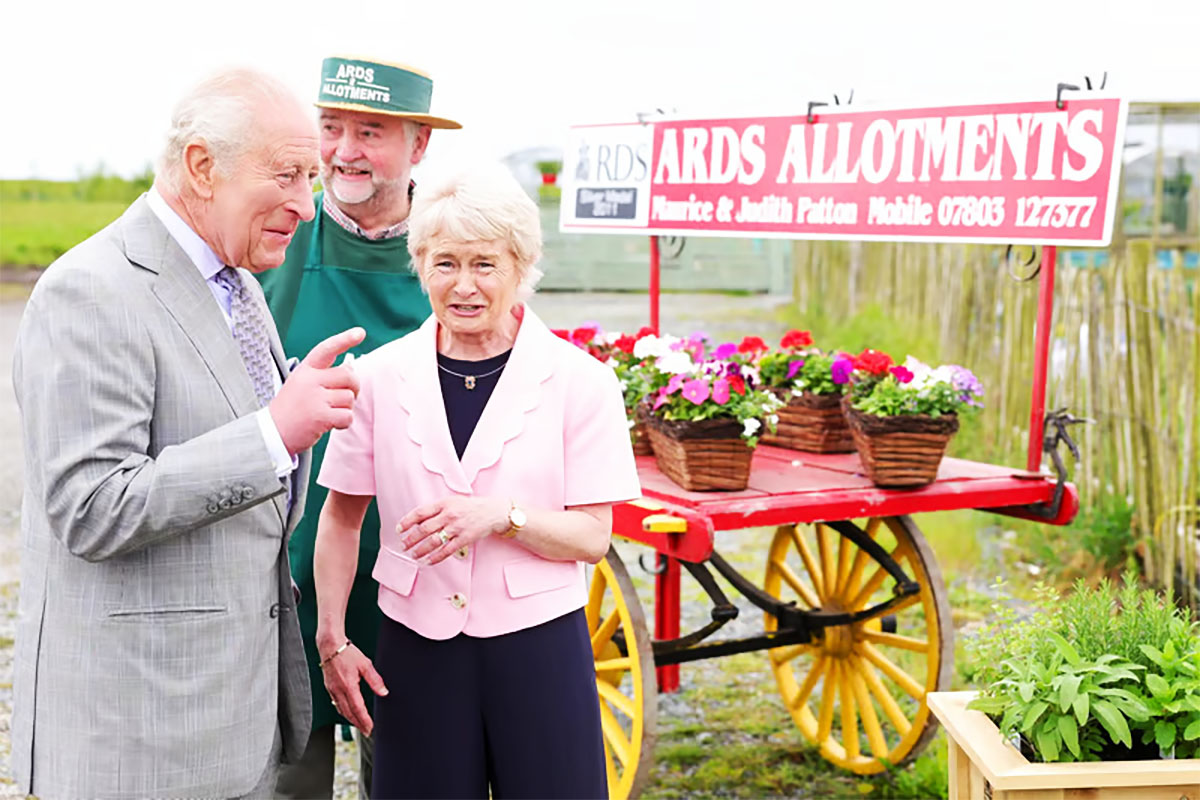 Day Three, May 21 — Ards Allotments and Conway Square, Newtownards: A Garden, a Community, and a Royal Farewell
The third and final day opened with a visit that spoke directly to one of the King’s deepest and most abiding passions. His Majesty travelled to Ards Allotments, situated just outside Newtownards in County Down — and from the moment he arrived, it was clear that here was a King entirely and joyfully in his element. Few topics animate King Charles quite as readily as the subject of allotments and the art of growing — the relationship between people and the land they tend, the community that forms around shared soil, the quiet but profound satisfaction of nurturing something from seed to harvest. At Ards Allotments, he found all of this and more.
His Majesty was welcomed and shown around personally by the allotment’s founders, Maurice Patton and his wife Judith — a couple whose story carries, at its heart, a remarkable royal connection. Maurice had been inspired to create Ards Allotments in 2006 after watching the King — then Prince of Wales — visit a similar growing space on the television news. That single broadcast had planted a seed of its own, and two decades on, the allotment that grew from that moment of inspiration now stands as a flourishing community resource, rich in produce, purpose, and human warmth. The King was visibly moved by the story, and the conversation between Maurice, Judith, and their royal guest flowed with the ease and enthusiasm of people who share a genuine and deep-rooted love of the subject. His Majesty moved through the plots with great interest, pausing to examine what was growing, asking questions with the knowledgeable curiosity of a lifelong grower, and listening intently to all that Maurice and Judith had built and nurtured from the ground up.
Allotment owners and representatives of local community groups had gathered to greet the King, and he took the time to meet each of them — talking, asking, and listening with the attentiveness that has always marked his most personal engagements. Among those present were volunteers and members from the South Eastern Health and Social Care Trust and Decorum Northern Ireland, an organisation dedicated to supporting members of the security forces who served through the years of the Troubles. In this quietly extraordinary patch of County Down earth, His Majesty encountered a community devoted not only to growing food, but to growing confidence, connection, and hope — values that have long sat at the very heart of his own life’s work.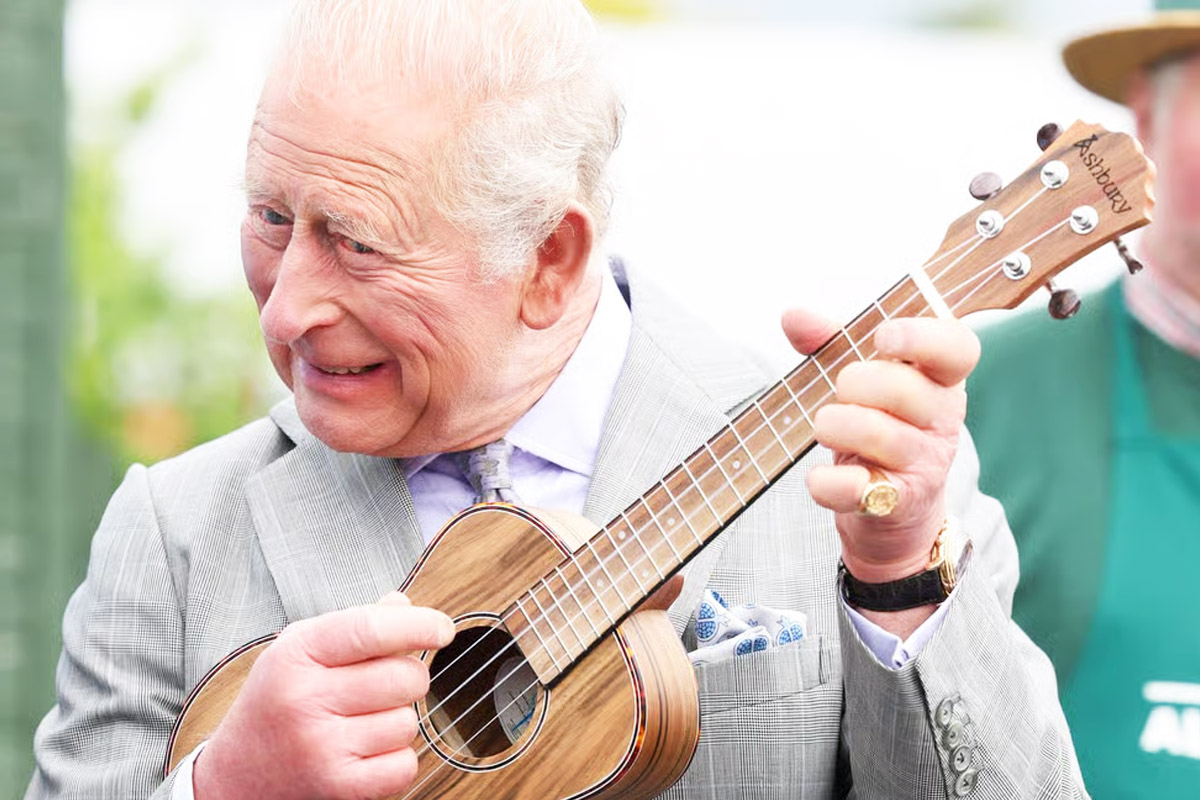
Then, in the most joyful and entirely unexpected way, the final morning found its crowning musical moment. The Loughries Men’s Shed Ukulele Ensemble — a community group whose very existence speaks to the enduring spirit of togetherness that defines so much of Northern Ireland’s social fabric — had gathered at Ards Allotments to perform for His Majesty. When a ukulele was placed in the King’s hands, he did not hesitate for a moment. He raised the instrument, pressed it thoughtfully to his ear to find the note, and began to strum with a George Formby-inspired flourish that drew immediate and delighted cheers from everyone present. “There’s a marvellous organisation called the Ukulele Orchestra of Great Britain — it’s fantastic,” he told the beaming ensemble. When one enthusiastic player suggested that a booking at the London Palladium might now be in order, the King responded with a broad grin: “It’s such a great instrument. Do you remember the words? Wait ’til you get to my age!” The musicians, deeply touched by the royal participation, told His Majesty it had been the greatest of honours — and the allotment gardens rang with laughter, music, and the kind of warmth that no formal occasion could ever quite replicate.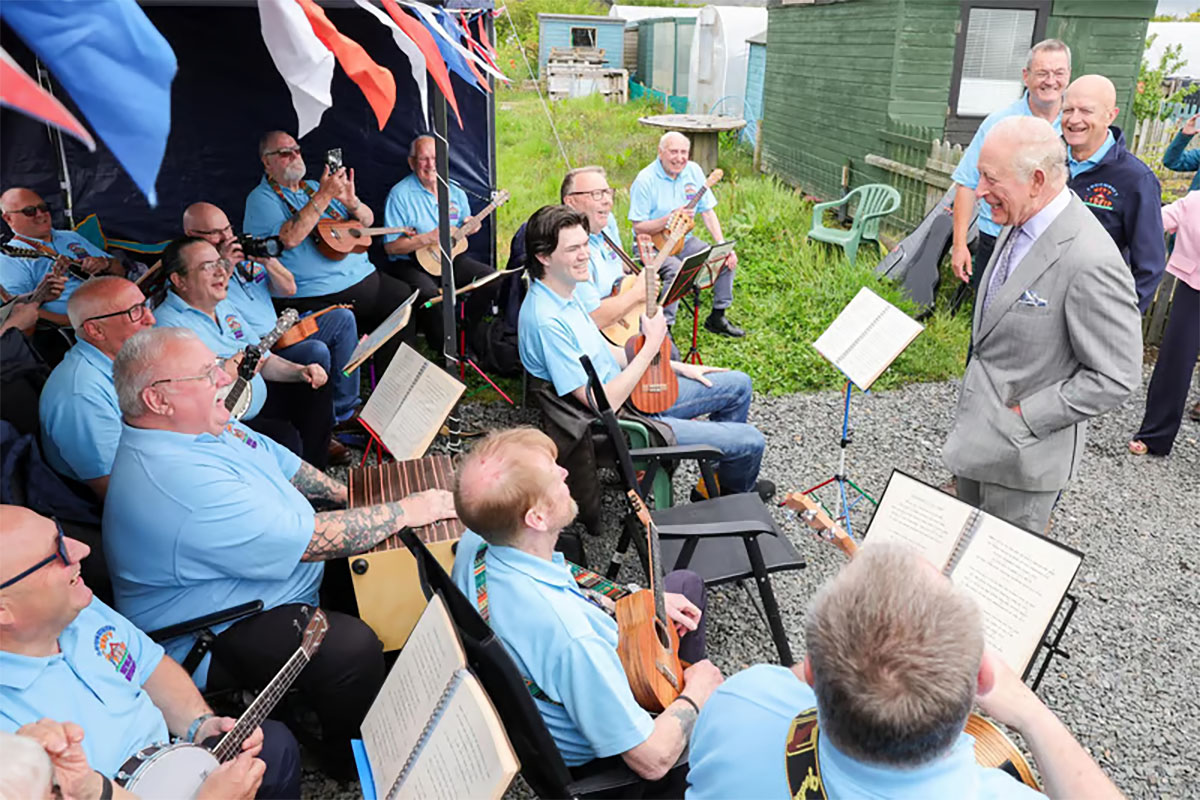
Queen Camilla, resplendent in a blue and white wool crepe dress beneath a scallop-edged jacket by Bruce Oldfield — finished with a turquoise three-leaf clover brooch that seemed made for the occasion — made her own perfectly judged and utterly memorable contribution to the day at Cafolla’s, a beloved local ice cream business with more than a century of history woven into its story. She accepted a cone with the delight of someone who had been thoroughly looking forward to the moment, dipped her wafer in with great concentration, and then declared with a wide smile: “Can I stay here? Can I stay and eat it all?” She announced the ice cream to be her lunch, reluctantly passed the cone to her equerry, and then — inevitably and irresistibly — retrieved it moments later for one final, thoroughly satisfying taste. “The Queen told me she could stay here a bit longer,” the proprietor said afterwards, still glowing with pleasure.
Bringing Their Majesties’ visit to Northern Ireland to a most fitting and joyful close, the King and Queen came together for a visit to Conway Square, in the very heart of Newtownards, to join a celebration of the town and its remarkable community. Conway Square — the proud civic heart of this vibrant County Down town — was alive with colour, music, and the unmistakable warmth of a community that had turned out in its entirety to welcome and honour its King and Queen. The square rang with cheering voices and the sound of celebration as Their Majesties arrived, moving among the crowds with the ease and genuine pleasure of two people deeply glad to be exactly where they were. Families gathered from every corner of the town, flags were raised, and the air was filled with the kind of spontaneous, heartfelt joy that no official programme could ever quite choreograph. The King and Queen paused time and again to speak with well-wishers, to receive the gifts and greetings pressed upon them with such generosity of spirit, and to share in the pride and warmth of a town celebrating not only the royal visit, but the richness of its own community life. It was, in every sense, the most perfect of farewells — a King and Queen standing at the very centre of a town that loved them, in a square that had become, for one glorious May morning, the most joyful place in all of Northern Ireland.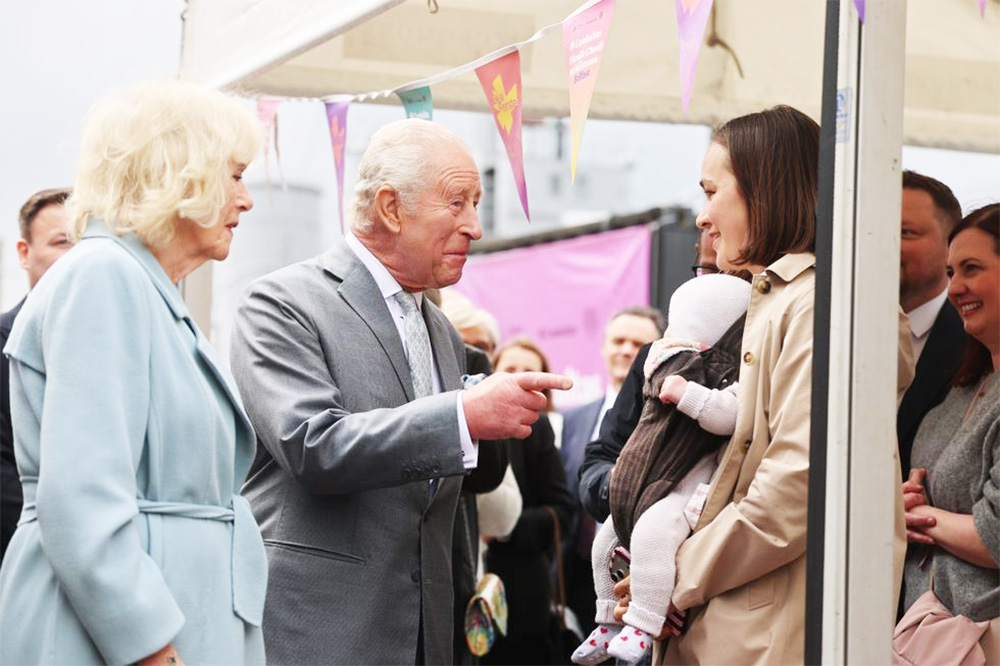
A Tour That Lifted Every Heart It Touched
Three days of music, warmth, laughter, and genuine human connection — the May 2026 royal tour of Northern Ireland was, by every measure, a triumph of the spirit. From the bodhrán drums played together in the rain at Thompson Dock, to the ukulele strummed with gleeful abandon among the community growers at Ards Allotments; from the jar of local honey and the fragrant wheaten bread at The Pantry Foodbank in Newcastle, to the pint of Guinness poured with such care and pride at The Parson’s Nose in Hillsborough; from the dog petted with such spontaneous affection in the village streets, to the ice cream savoured with unguarded joy at Cafolla’s, to the cheering, celebrating crowds of Conway Square in the heart of Newtownards — King Charles and Queen Camilla offered something far rarer than ceremony throughout these three remarkable days. They offered themselves, openly and joyfully, to every community they visited.
And Northern Ireland received them in the manner for which it is so rightly celebrated — with a hospitality that is instinctive, generous, and deeply felt. This is a land where the stranger at the door is made welcome before a word of introduction has been spoken, where warmth is not a gesture but a way of life. The people who lined the streets and filled the squares did so not out of duty, but out of genuine affection — arriving early, staying late, calling out their love across the crowd. An eleven-year-old boy brought a box of freshly-laid eggs. A woman of one hundred and two stood proudly in the May air. Volunteers at a foodbank pressed a jar of honey and a loaf of wheaten bread into the hands of their King. A voice in Newcastle declared with simple and absolute sincerity: “I will never forget this.” These are not the footnotes of a royal visit — they are its very heart.
That spirit of welcome is woven into the fabric of Northern Ireland itself — a place of ancient hills and harbour light, of traditions carried across centuries and cultures brought together in remarkable harmony. It is a land whose music has filled the world’s great concert halls and whose stories have shaped the global imagination. It is a place where a school in south Belfast counts forty-five nations among its pupils and speaks forty-seven languages in its corridors, where a village pub becomes a stage for royal laughter and a perfectly poured pint, where Mexican dancers spin in brilliant traditional dress on the Belfast waterfront, and where an allotment founded just outside Newtownards — inspired by a glimpse of a prince on a television screen — grows, year by year, into a community of healing, purpose, and abiding hope. This is the Northern Ireland that greeted its King and Queen in May 2026 — confident, generous, culturally magnificent, and entirely, gloriously itself.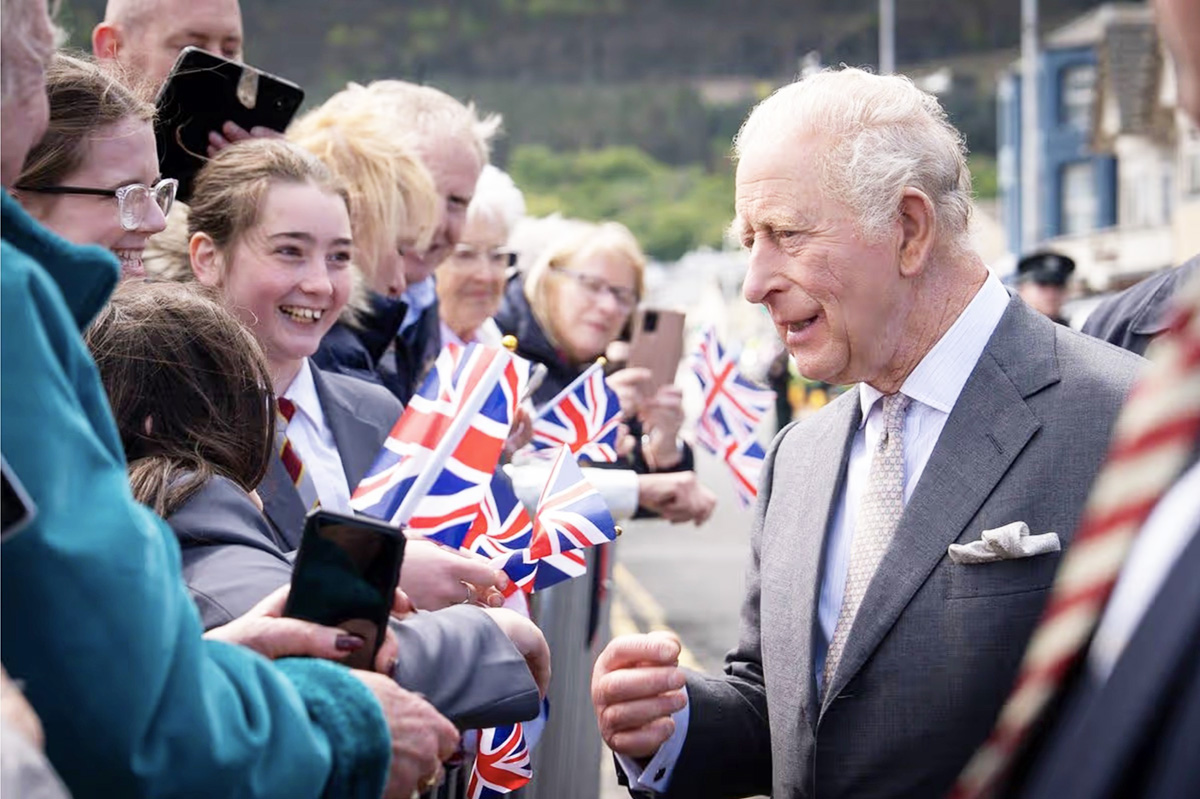
His Majesty King Charles III has visited the region more than forty times over the course of his lifetime — each visit a thread woven into a longer, ever-strengthening bond. This tour, unannounced and all the more powerful for it, added something new to that history: a sense not of formality observed, but of friendship deepened and trust renewed. The King played music with its people — not once, but twice, on bodhrán and ukulele alike. He spoke with growers and gardeners with the passion of a man who has spent a lifetime championing the land. He received honey and warm wheaten bread from the hands of volunteers who give their best so that others may thrive. He sat with First Minister Michelle O’Neill and Deputy First Minister Emma Little-Pengelly and demonstrated, in the warmth of that Hillsborough meeting, that the bonds between the Crown and Northern Ireland’s civic leadership are as strong and as genuine as ever. The Queen poured a pint, petted a dog, ate an ice cream, and laughed without reservation — meeting every moment with the warmth and grace that has come to define her so beautifully. Together they stood in Conway Square and received the love of a town that had come out in its entirety to celebrate with them. Together, they planted a tree in the grounds of Hillsborough Castle — as if to say, quietly and with great meaning, that what grows here matters, and that they intend to watch it flourish.
What this tour revealed, above all else, was the extraordinary power of two people who lead not from distance but from genuine closeness — a King and a Queen who understand instinctively that the greatest thing a sovereign can offer is not grandeur, but presence. In every room they entered, in every street they walked, in every hand they shook and every smile they returned, Their Majesties King Charles and Queen Camilla gave Northern Ireland the gift of themselves — fully, warmly, and without reserve. And Northern Ireland, with the incomparable grace, hospitality and generosity that defines its finest character, gave it all back in equal measure.
The three days of May 2026 were unquestionably, magnificently and when King Charles III and Queen Camilla departed Conway Square and turned their faces homeward, they left behind not only the warmth of their presence but the indelible impression of two people who had given of themselves with a generosity as rare as it is inspiring. They came to a land of extraordinary beauty, culture, and human spirit — and that land rose to meet them with everything it had. The bodhrán beat at Thompson Dock, the ukulele rang at Ards Allotments, the Guinness was poured in Hillsborough, the ice cream was laughed over in Newtownards, and through it all, the people of Northern Ireland showed the world exactly who they are: warm, proud, joyful, and utterly magnificent. The Crown and its people were, in those three golden days, the very best of each other — and that, above all things, is what history will honour and remember.
