

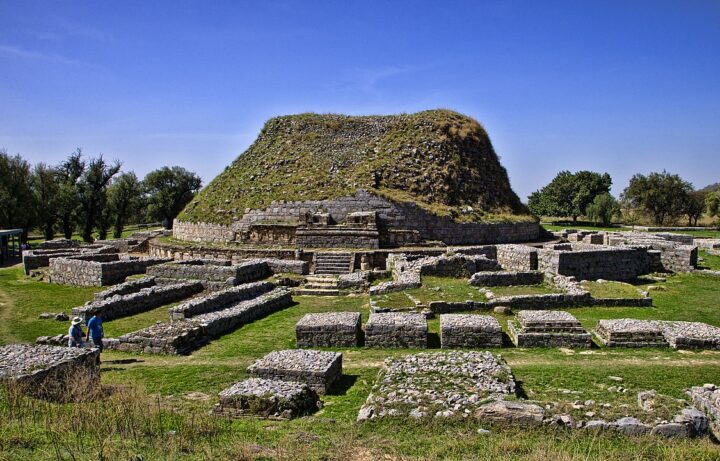
From the ancient Neolithic tumulus of Saraikala to the ramparts of Sirkap (2nd century B.C.) and the city of Sirsukh (1st century A.D.), Taxila illustrates the different stages in the development of a city on the Indus that was alternately influenced by Persia, Greece and Central Asia and which, from the 5th century B.C. to the 2nd century A.D., was an important Buddhist centre of learning. Nestled in the lush green valleys of Punjab, Pakistan, the ancient city of Taxila stands as one of the most remarkable archaeological treasures of South Asia.
Dating back over 2,500 years, it was once a flourishing center of learning, culture, and trade along the historic Silk Road. Known in ancient times as Takshashila, this legendary city served as a major seat of Buddhist scholarship and attracted scholars from across the ancient world, including the famous philosopher Chanakya and students of the Vedic tradition. Its strategic location between the Indus and Jhelum rivers made it a melting pot of civilizations — from the Achaemenid Persians and Greeks under Alexander the Great to the Mauryan, Indo-Greek, Kushan, and later Gandharan empires — each leaving behind a rich layer of architectural and artistic heritage.
The ruins of Taxila reveal a stunning blend of Hellenistic, Persian, and Indian influences, most notably seen in the exquisite Gandharan art that flourished here between the 1st and 5th centuries CE. Stupas, monasteries, and temples dot the landscape across three major sites: Bhir Mound, Sirkap, and Sirsukh, along with the sacred Dharmarajika Stupa and the Jaulian Monastery perched on nearby hills. The Greco-Buddhist sculptures discovered here, with their realistic portrayal of the Buddha and delicate drapery inspired by classical Greek styles, represent one of the earliest and finest expressions of Buddhist iconography. These serene stone carvings, often adorned with lotus motifs and narrative reliefs from the life of the Buddha, continue to captivate historians and art lovers alike.
Recognized for its outstanding universal value, Taxila was inscribed as a UNESCO World Heritage Site in 1980, preserving its legacy as a cradle of ancient knowledge and cross-cultural exchange. Today, the Taxila Museum houses thousands of artifacts — coins, jewelry, pottery, and statues — offering a tangible connection to a glorious past. Walking through its sunlit corridors and among the weathered stones of the ancient city, one can almost hear the echoes of scholars debating philosophy, monks chanting sutras, and merchants bargaining in forgotten tongues. Taxila remains not just an archaeological wonder, but a timeless testament to human curiosity, faith, and the enduring power of cultural harmony.



 Own or work here?