
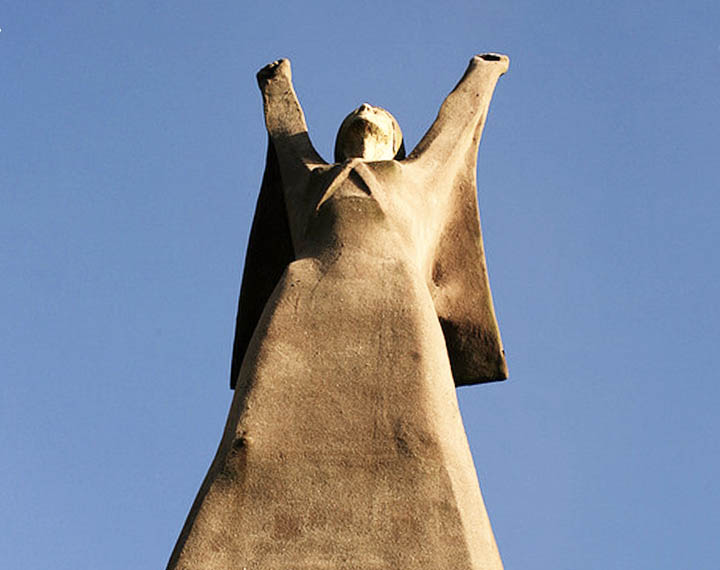
La Pasionara or “The Passionflower” in English is a stylized female figure. La Pasionara references Dolores Ibárruri, a heroine of the Spanish Civil War, who was known by that her sobriquet. An almost featureless, the statue is nevertheless full of movement, arms raised crying out for justice. Nestled along the banks of the River Clyde at Custom House Quay, the La Pasionaria Monument stands as a bold tribute to the unyielding spirit of anti-fascist resistance. Crafted in fiberglass by Liverpool sculptor Arthur Dooley between 1977 and 1979, the nine-foot statue depicts Dolores Ibárruri, the fiery Spanish communist leader known as La Pasionaria, or “The Passion Flower.”
With arms thrust skyward in defiant salute and her face turned toward the heavens, she embodies the rallying cry etched into her pedestal: “Better to die on your feet than live forever on your knees.” Unveiled in December 1979 by the International Brigade Association of Glasgow, this Category B-listed artwork honors the 2,100 British volunteers who joined the fight against Franco’s forces in the Spanish Civil War, including 65 brave souls from Glasgow itself who never returned home.
The monument’s creation was no quiet affair; it ignited fierce political flames in a city already steeped in labor and socialist fervor. Commissioned to commemorate the International Brigades’ sacrifices from 1936 to 1939, the project faced vehement opposition from Conservative councillors who decried it as a provocative communist emblem and vowed to dismantle the “horrid monument to a horrendous hag” if they gained power. Labour leaders pushed forward undeterred, installing the statue in the predawn hours to sidestep protests, only to face a tense unveiling ceremony in February 1980 marred by counter-demonstrations and calls to replace Ibárruri with a figure like Winston Churchill. Yet, amid the uproar, the work captured Glasgow’s deep-rooted solidarity with global struggles against tyranny, transforming a simple riverside spot into a symbol of collective courage.
Over four decades later, La Pasionaria endures as a poignant reminder of Glasgow’s radical heart, gazing southward across the Clyde as if urging passersby to reflect on history’s hard-won lessons. Though the echoes of the Spanish Civil War have faded, the statue’s presence continues to stir quiet conversations among cyclists, historians, and tourists who pause to read its inscriptions and ponder the human cost of ideology. In a world still grappling with echoes of division and authoritarianism, this fiberglass sentinel—rising defiantly from its Corten steel base—affirms that the fight for dignity and justice remains as timeless as the river it overlooks, inspiring new generations to stand tall rather than kneel.



 Own or work here?