

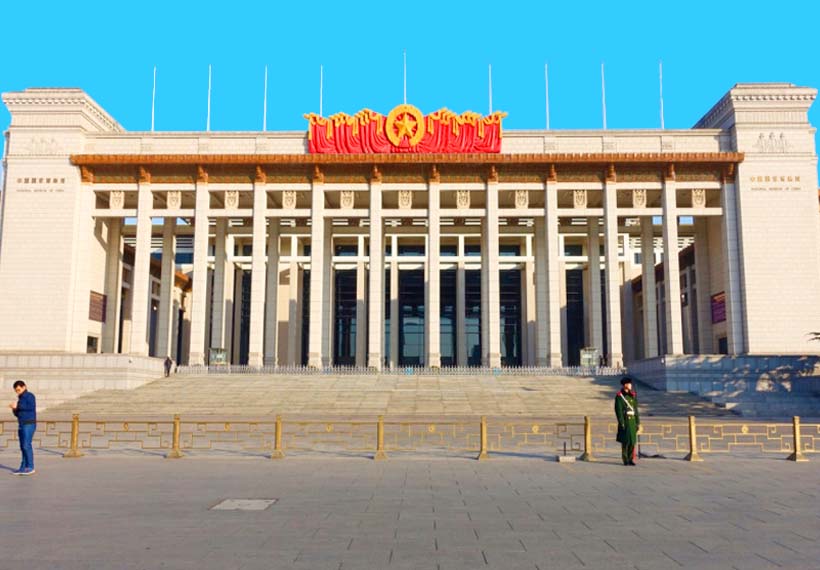
Standing majestically on the eastern side of Tiananmen Square, the National Museum of China is one of the world’s largest and most significant cultural institutions, embodying both the depth of China’s ancient civilization and the evolution of its modern identity. Established in 2003 through the merger of the Museum of the Chinese Revolution and the National Museum of Chinese History, it represents a monumental narrative of more than five thousand years of continuous civilization. The museum’s grand neoclassical façade and immense halls serve as a powerful symbol of national pride, bridging the imperial past with the contemporary state and reminding every visitor of China’s enduring cultural and artistic influence on the world.
Inside, the museum’s collections are staggering in both scale and diversity. From prehistoric jade relics and Neolithic pottery to Tang dynasty sculptures, Ming porcelain, and Qing imperial robes, each gallery immerses visitors in a different era of dynastic splendour. Among its most treasured pieces is the Simuwu Ding, the largest ancient bronze vessel ever unearthed, dating back to the Shang dynasty. Nearby, ancient calligraphy, Buddhist statuary, and exquisite silk paintings capture the refinement of Chinese artistry through the ages. Equally compelling is the museum’s modern wing, which chronicles the profound political and social transformations of the twentieth century — including the fall of the Qing dynasty, the May Fourth Movement, and the establishment of the People’s Republic of China in 1949.
Culturally, the National Museum of China serves as both a guardian of heritage and a platform for dialogue between past and present. It embodies the Chinese philosophy that history is not merely to be remembered, but continuously interpreted and revitalized. For tourists, walking through its vast marble corridors is a journey through time, offering insight into how China sees itself — not as a civilization of fragments, but as a living continuum.
Architecturally, its grandeur complements the monumental symmetry of Tiananmen Square, directly facing the Great Hall of the People across the vast plaza. The museum’s vast atrium, bathed in natural light, creates an atmosphere of quiet awe, inviting visitors to pause and reflect on the magnitude of human creativity. Whether one comes to study its priceless artefacts, experience its world-class exhibitions, or simply stand in reverence before millennia of history, the National Museum of China offers not just a window into the nation’s soul, but a profound encounter with the enduring story of civilization itself.
Free, massive (2.2 million-sq.-ft.) museum of Chinese history & art with more than 1 million relics. The National Museum of China sits to the east of Tiananmen Square and south of Chang’an Street, opposite to the Great Hall of the People. Finished at the same time, the National Museum of China and the Great Hall of the People were both among the ‘Ten Great Constructions’ completed for the 10th birthday of the PRC.
It was built on the basis of the former Museum of Chinese History and the former Museum of Chinese Revolution, being the most inclusive museum of time-honored Chinese culture and history in the country. After four year’s renovation and expansion, the new National Museum of China reopened in March, 2011 ranks among the largest modern museums in the world.



 Own or work here?