

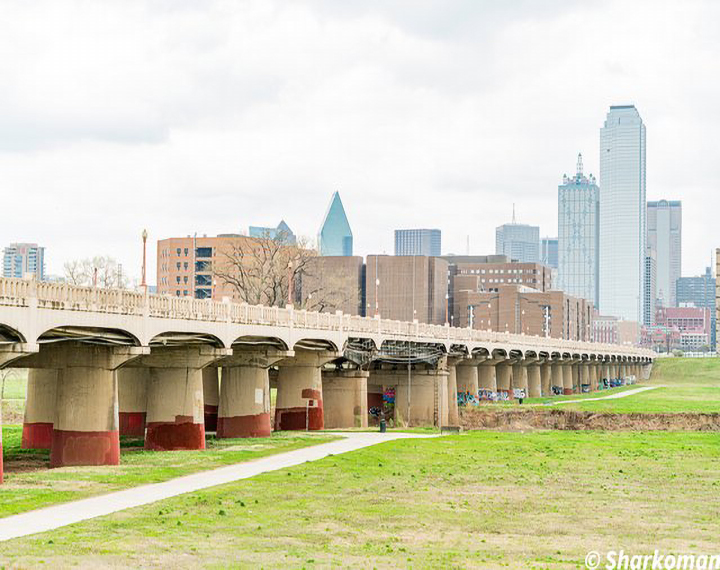
On the western edge of Dealey Plaza, where Commerce Street meets the memory of the old Trinity River channel, a modest Texas Historical Marker stands on ground of extraordinary significance — for it was here, in 1842, that Dallas truly began. It was at this precise point on the river that John Neely Bryan, a Tennessee-born lawyer, trader, and visionary who had settled on the east bank of the Trinity just one year earlier, launched the first ferry crossing in what would become one of the great cities of America. Bryan had chosen his ground with remarkable instinct: this natural ford was the only viable crossing of the Trinity for miles in either direction, a route long used by the Caddo, Creek, and Shawnee peoples before any European settler had laid eyes upon the Texas plains. By establishing his ferry here, Bryan did not merely offer a convenience — he created the essential artery through which the commerce, the settlers, and the ambitions of a fledgling frontier community would flow.
The ferry Bryan operated was a simple but vital enterprise: a flat-bottomed wooden platform, large enough for a single wagon and team, guided across the river’s current by rope and muscle. It was slow, sometimes unreliable, and subject to the caprices of a river prone to dramatic seasonal swings — yet it was indispensable. Every merchant, every family, every head of cattle bound for the markets beyond the Trinity depended upon this crossing. Bryan’s small settlement grew steadily around it, drawing settlers who recognised the value of a river ford as the natural nucleus for trade. He established a post office, a general store, and a log cabin that served as the community’s first courthouse. In 1844 he commissioned the first survey and plat of Dallas, and by 1846 had been instrumental in organising Dallas County itself, with his riverside settlement chosen as the county seat. A city was taking shape, and its foundation was a rope, a raft, and a river.
In 1852, Bryan — beset by restlessness and the mounting pressures of frontier life — sold his entire Dallas holdings, including the ferry concession, to Alexander Cockrell, a Kentucky-born entrepreneur of formidable energy and vision, for the sum of seven thousand dollars. Cockrell saw immediately what the ferry represented and what it could become. In 1854 he replaced it with a covered wooden toll bridge — the first bridge ever to span the Trinity River at Dallas — acquiring hundreds of acres of surrounding land to protect his investment and anchor his growing commercial empire. The bridge transformed the crossing from a slow, weather-dependent passage into a reliable, permanent artery of trade, and the economic consequences were immediate and dramatic. Architects, contractors, carpenters, and investors poured into Dallas, and the city’s first true era of expansion began in earnest.
When Alexander Cockrell was killed in a gunfight in 1858, his remarkable wife Sarah Horton Cockrell — who had managed all of the family’s correspondence and finances because her husband could neither read nor write — took command of the enterprise with a composure and brilliance that made her the most consequential figure in the early economic history of Dallas. After the original bridge collapsed, she restored ferry services across the same crossing Bryan had first opened sixteen years before. Then in 1872, having won approval from the Texas State Legislature, she financed and completed the first iron bridge across the Trinity, a graceful two-arch structure of St. Louis ironwork stretching three hundred feet over the river. It was, according to one of the era’s most respected publishers, one of the handsomest iron bridges in America. By the time of her death in 1892, Sarah Cockrell owned nearly a quarter of what is now Dallas’s Central Business District — and it had all begun at this river crossing



 Own or work here?