

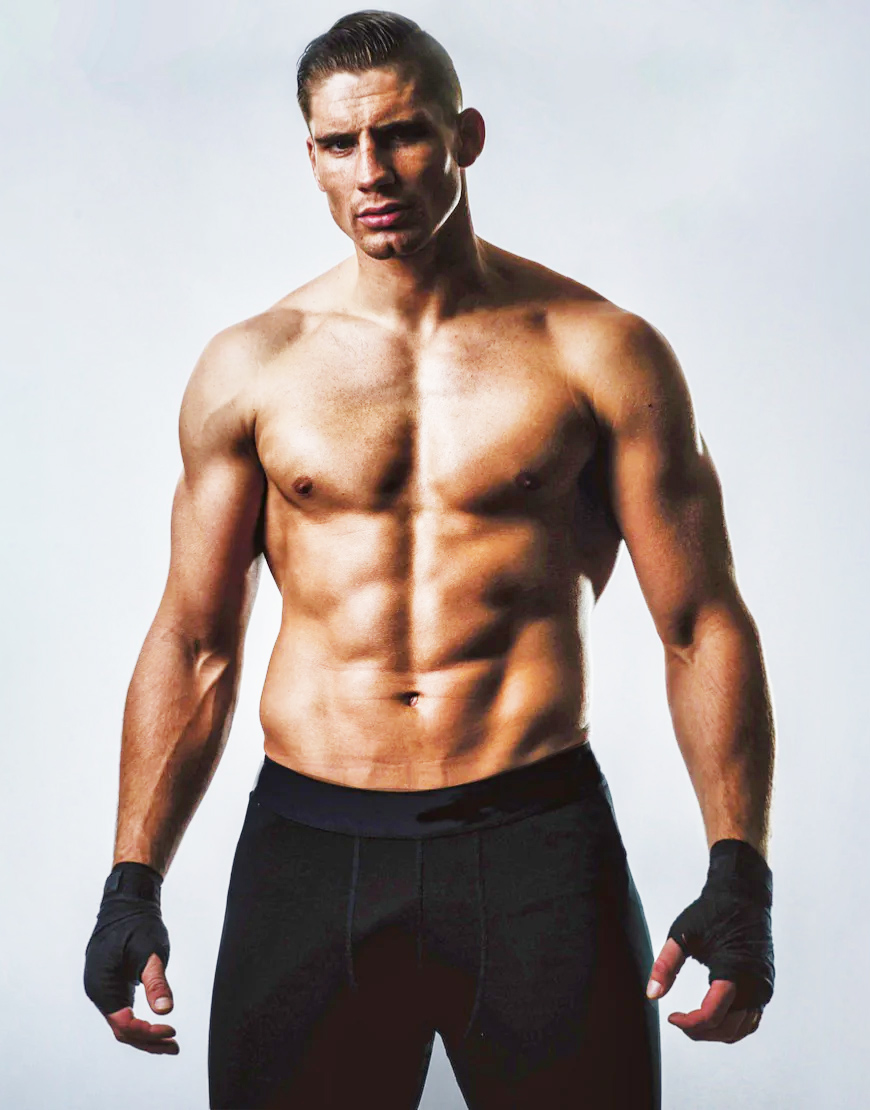
The King of Kickboxing and the Courage of a Champion Twelve years unbeaten — and still hungry for the greatest challenge of all.
Rico Verhoeven was born on the 10th of April 1989 in Bergen op Zoom, in the Netherlands, into a family where discipline, hard work and martial spirit ran deep. His father, a karate black belt, introduced him to the martial arts at the age of five, beginning with Kyokushin — the full-contact style known for its ferocious physical demands and its insistence on mental fortitude above all else. It was a foundation that would prove unshakeable. By the age of sixteen, the towering, naturally gifted Verhoeven was already competing as a professional, his exceptional frame and extraordinary athleticism setting him apart from fighters many years his senior. What he possessed beyond physical gifts was rarer still: an insatiable hunger to improve, a mind that approached the art of fighting with the methodical intelligence of a strategist, and a character that held itself to the highest possible standard both inside the ring and beyond it. From those formative years in the gyms of the Netherlands, Rico Verhoeven was building something that would one day become the most dominant reign in the history of heavyweight kickboxing — and a legacy that transcends the sport entirely.
Verhoeven turned professional in kickboxing in 2008, rising rapidly through the ranks and competing in organisations such as It’s Showtime and K-1 before joining Glory in 2012. It was within Glory that his greatness found its fullest expression. His crowning moment arrived in 2013 at Glory 11, where he claimed the heavyweight championship in a tournament that showcased his strategic brilliance against elite opponents including Gökhan Saki and Daniel Ghiță. Once he held the title, he did not merely defend it — he elevated it, fight by fight, year by year, into something the sport had never quite seen before. He successfully defended the Glory Heavyweight Championship more than a dozen times against the very best contenders in the world — Badr Hari, Benjamin Adegbuyi, Jamal Ben Saddik and Tarik Khbabez among them — each defence a masterclass in technical precision, physical power and the kind of calm under pressure that only a truly great champion can sustain. The 2017 encounter against the 6’9″, 280-pound Jamal Ben Saddik, dubbed the biggest fight in kickboxing history, drew 20,000 fans and millions of viewers worldwide, with Verhoeven’s fifth-round TKO turning a David-and-Goliath narrative triumphantly on its head. He was ranked the number one heavyweight kickboxer in the world by Combat Press from the moment those rankings were first established in September 2014, and he never once relinquished that position.
Verhoeven held the undisputed Glory Heavyweight World Championship from 2013 until 2025, remaining unbeaten for an extraordinary 4,418 days — twelve uninterrupted years at the absolute summit of his sport. It is a record of sustained excellence that has no equal in the history of heavyweight combat sports, and one that places him in the company of the very greatest sporting champions the world has ever produced. Yet the numbers alone do not capture the full truth of what that reign meant. It meant showing up, year after year, with a target on his back and the ambitions of every challenger in the world aimed directly at him. “I’ve been having a target on my back for such a long time because I have what people wanted,” he has said — and in those words is the entire story of a champion who not only reached the summit but made it his permanent home. In November 2025, at the height of his dominance and entirely on his own terms, Verhoeven chose to vacate the title by his own decision, closing one extraordinary chapter in order to pursue an even greater challenge. It was the act of a man who has never once been content to stand still, and who has always measured his worth not by what he has already achieved, but by what still lies ahead.
Beyond the ring, Rico Verhoeven has built a life of remarkable breadth, purpose and warmth. He is a devoted father and a committed philanthropist, championing children’s causes and giving generously of his time, his profile and his resources to those who need it most. His autobiography, published in 2017 under the simple and fitting title Rico, sold out nationwide in the Netherlands, becoming a number one bestseller that captured the public’s imagination and introduced the world to the man behind the champion — his mindset, his struggles, his philosophy and his unshakeable belief in the power of hard work and self-belief. He is frequently engaged as a public speaker for organisations ranging from NGOs and non-profit foundations to professional football teams and groups of young people, carrying a message that resonates far beyond sport: that the discipline, resilience and courage forged in the gym are not confined to it — they are a way of living, applicable to every challenge and every ambition. His natural communication talent led him into the world of acting, with roles in Hollywood productions including Kickboxer: Retaliation alongside Jean-Claude Van Damme, and the acclaimed Black Lotus and Den of Thieves: Pantera — films in which he brought to the screen the same authenticity, intensity and commanding presence that has defined his entire career.
Rico Verhoeven has always understood that sport, at its greatest, carries a meaning beyond competition. He has used his extraordinary platform — his millions of followers, his crossover fame, his global reach — to inspire a generation of young people who may never step into a ring but who draw from his example the courage to pursue their own ambitions with everything they have. His approach to the journey ahead of his historic boxing debut against Oleksandr Usyk at the Pyramids of Giza on the 23rd of May 2026 has been characteristically fearless and grounded. “The most important thing is to enjoy the process instead of enjoying just the fight,” he has said. “I just try to keep it level and try to be crazy excited and thankful.” Of the fight itself — the most audacious crossover challenge in the history of combat sports — he has spoken with the quiet confidence of a man who has spent his entire life doing what others said could not be done: “Undisputed versus undisputed. Two different worlds collide with each other. I think it’s a crazy movie script.” And of his preparation: “I’ve been kickboxing since the age of six, and I’ve been working with Team Fury since 2010 or 2011 — I’ve sparred everybody. So I’m used to keeping my legs on the ground.”
The legacy of Rico Verhoeven is one that will endure long after the final bell of any fight has rung. He arrived in the sport as a prodigy, grew into a champion and has become something rarer and more lasting than either — an icon. His twelve-year reign established him as the undisputed face of heavyweight kickboxing worldwide, and his decision to vacate that throne not in defeat but by his own sovereign choice, in order to test himself against the greatest boxer on the planet, speaks to a spirit that cannot be contained by any single title, any single sport or any single definition of greatness. He has shown, throughout a career of extraordinary length and consistency, that true champions are not made in the moments of triumph but in the daily, unglamorous, unrelenting commitment to being the very best version of themselves. He has shown that a life built on discipline can accommodate joy, generosity and grace. He has shown that the pursuit of one more challenge — one more summit, one more impossible horizon — is not recklessness, but the most honest expression of what it means to be fully, magnificently alive. The King of Kickboxing steps into the boxing ring at one of the most spectacular venues on earth, and whether the outcome brings him a new crown or the honour of the most courageous attempt, Rico Verhoeven’s place among the immortals of combat sport is already, and permanently, secure.



 Own or work here?