

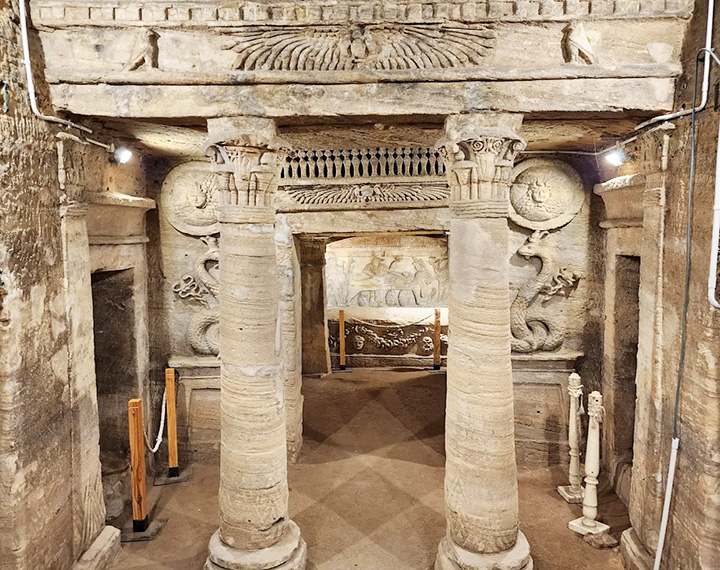
The Catacombs of Kom el Shoqafa, located in Alexandria, Egypt, represent one of the most remarkable archaeological discoveries from the ancient world. Carved entirely out of solid rock in the second century AD, this vast underground burial complex was originally intended as a private family tomb but eventually expanded to accommodate hundreds of bodies. Discovered accidentally in 1900 by a donkey that fell into a shaft, the site descends more than 100 feet below ground level through a spiraling staircase, featuring multiple levels of chambers, galleries, and tombs that blend Greco-Roman and Egyptian architectural styles in a unique cultural fusion.
The catacombs showcase an extraordinary syncretism of religious and artistic traditions. Visitors encounter intricate carvings and statues that combine Egyptian deities like Anubis and Sobek with Roman and Greek motifs, including serpents, eagles, and mythological scenes. The central hall, known as the Rotunda, leads to the principal burial chamber adorned with detailed reliefs, while smaller niches and loculi hold the remains of both wealthy citizens and commoners. This harmonious mixture reflects Alexandria’s role as a cosmopolitan melting pot during the Ptolemaic and Roman periods, where different cultures coexisted and influenced one another.
Today, the Catacombs of Kom el Shoqafa stand as a UNESCO tentative World Heritage site and a major tourist attraction, offering a fascinating glimpse into ancient funerary practices and beliefs about the afterlife. Despite centuries of looting and natural decay, the preserved sculptures, wall paintings, and architectural ingenuity continue to impress historians and travelers alike. The site remains a testament to the engineering skills and cultural openness of its builders, making it one of the Seven Wonders of the Middle Ages in historical accounts.



 Own or work here?