

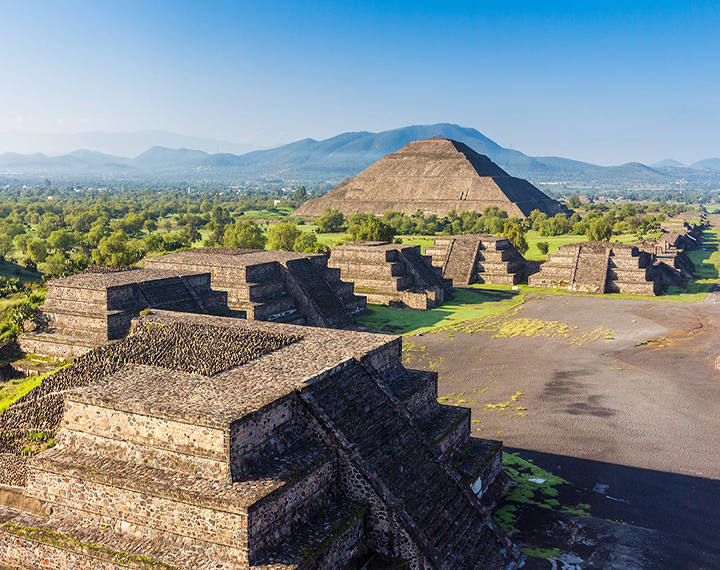
Teotihuacán was once one of the largest and most influential cities in the ancient world, flourishing between the first and seventh centuries. Located northeast of present-day Mexico City, it was a vast, carefully planned urban center that shaped religious, political, and cultural life across Mesoamerica. Its name, given later by the Aztecs, means “the place where the gods were created,” reflecting the profound spiritual significance the city held long after its decline.
The city’s grand layout centers on the Avenue of the Dead, framed by monumental structures such as the Pyramid of the Sun, the Pyramid of the Moon, and the Temple of the Feathered Serpent. Teotihuacán’s architecture reveals advanced knowledge of engineering, astronomy, and symbolism, while its murals and residential compounds tell stories of ritual life, trade, and a multicultural population drawn from distant regions. The city was not only powerful but deeply interconnected with nature and the cosmos.
Today, Teotihuacán is one of Mexico’s most important archaeological and cultural sites, drawing visitors from around the world. Recognized as a UNESCO World Heritage Site, it offers a profound journey into humanity’s ancient past, inviting reflection on creativity, belief, and the enduring legacy of civilizations that continue to shape Mexican identity.



 Own or work here?