

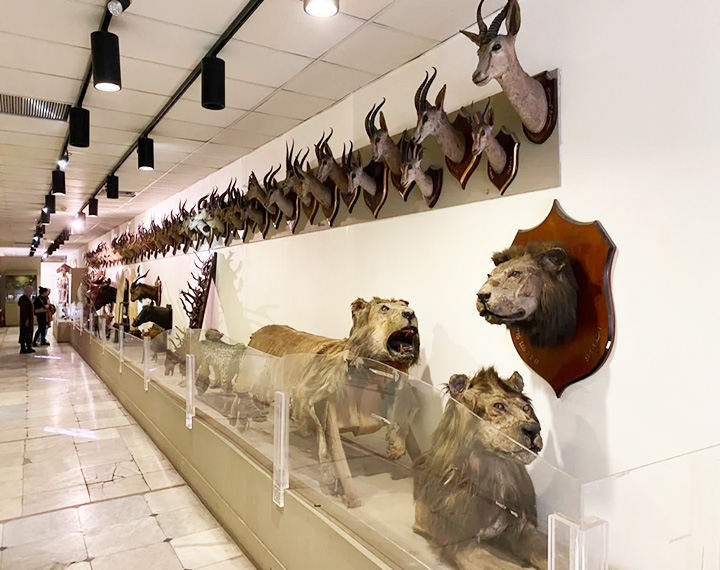
Tucked within the lush grounds of the magnificent Manial Palace on Roda Island, the Hunting Museum is one of Cairo’s most intriguing and utterly singular cultural attractions. Born from the passion of Egypt’s last royal dynasty for the great outdoors, this remarkable collection offers visitors a vivid and intimate window into a world of aristocratic adventure that has long since vanished from the Nile Valley. The story of the museum begins after the 1952 Revolution, when an inventory of the property of members of Egypt’s former royal family revealed a vast collection of animals and birds — and a section of the arched corridor beneath the palace walls was transformed into the Hunting Museum, with fifteen galleries displaying the collections of King Farouk, Prince Mohamed Ali Tewfik, and Prince Youssef Kamal. Ahram Online
The museum holds 1,180 exhibited objects, including preserved animals, birds, and butterflies, and also houses the skeletons of camels and horses that formed part of the sacred caravan that carried the Kiswa — the great embroidered cloth — on its journey to drape the Kaaba in Mecca. Cairo 360 This extraordinary detail elevates the museum far beyond its initial premise, connecting the royal hunting tradition to the deepest spiritual rhythms of Egyptian Muslim life. It is a detail that stops visitors in their tracks, inviting quiet reflection on the intersection of power, devotion, and the natural world.
Among the most beautiful and unique items on display is the butterfly collection of Prince Mohamed Ali Tewfik himself — a breathtaking assembly of 7,000 butterflies gathered over a lifetime of curious, devoted observation. Ahram Online Arranged with meticulous care, this collection alone speaks to a man of extraordinary sensibility — a prince who was as much naturalist as nobleman. The overall collection reflects the cosmopolitan lifestyle of Egyptian royalty, who participated in both traditional Middle Eastern hunting practices and adopted European-style safari expeditions.
A map highlighting hunting locations across Egypt that were used by Prince Mohamed Ali Tewfik forms part of the collection, alongside two large maps showing the distribution of bird species. Informational panels throughout the museum describe the original habitat and provenance of every animal on display. Ahram Online The museum’s designer brought the atmosphere of the jungle directly into the gallery spaces — with ambient jungle sounds, carefully considered lighting, and dramatically presented specimens that transform each room into an immersive tableau rather than a simple display case.
At the end of the visitor route, a dedicated workshop for children allows young visitors to draw the animals they have encountered throughout the museum — a thoughtful reminder that this space is as much about nurturing wonder in the next generation as it is about preserving the passions of the last royal dynasty. Viewed through a contemporary lens with openness and historical curiosity, the Hunting Museum is a profoundly humanising space — revealing princes not as distant figures of power but as fascinated collectors of the natural world, explorers of landscapes both local and far-flung, and men who found beauty in the creatures of the earth.



 Own or work here?