

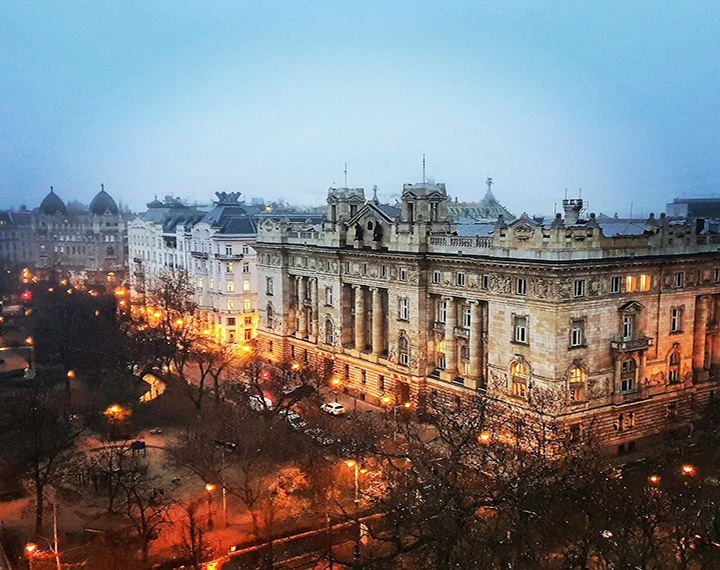
The National Bank of Hungary, or Magyar Nemzeti Bank, is a monumental landmark situated on the eastern side of Liberty Square. This grand edifice radiates an atmosphere of stability and historical weight, characterized by its late historicist style and ornate limestone carvings. It serves as an inviting destination for those interested in the intersection of high finance and artistic heritage, acting as the silent guardian of the nation’s economic sovereignty within a building that is itself a masterpiece of early 20th-century design.
* The facade is adorned with allegorical reliefs by sculptor József Róna, depicting various branches of commerce, industry, and agriculture.
* The interior features a spectacular grand staircase and a central hall illuminated by a massive stained-glass ceiling.
* It serves as the central bank of Hungary, responsible for the stability of the national currency, the Forint.
Culturally, the bank is much more than a financial regulator; it is a vital patron of Hungarian arts and numismatics. The institution maintains an extensive collection of historical coins, medals, and banknotes that trace the evolution of exchange in the Carpathian Basin over a millennium. By housing the Money Museum within its complex, the bank fosters a culture of financial literacy and appreciation for the aesthetic beauty of currency, making the complex world of economics accessible and engaging for the general public.
* The Money Museum (Pénzmúzeum) offers interactive exhibits where visitors can try their hand at virtual gold mining or gold bar lifting.
* The building’s architectural language was intended to project the power and independence of the Hungarian financial system during the Dual Monarchy.
* The bank regularly hosts temporary art exhibitions and cultural events in its dedicated gallery spaces.
Historically, the building was designed by Ignác Alpár and completed in 1905, originally serving as the headquarters of the Austro-Hungarian Bank. Its construction marked a pivotal moment in the urban development of the Lipótváros district, replacing a former military barracks with a symbol of civic and economic progress. Throughout the world wars and the shifts of the 20th century, the bank remained a resilient anchor of the state, preserving its magnificent original interiors and its role as the heart of the country’s financial life.
* The site was formerly part of the infamous “New Building” (Újépület), a prison that was demolished to make way for the square’s current grandeur.
* The bank played a crucial role in the introduction of the Forint in 1946, stabilizing the economy after the most severe hyperinflation in world history.
* The architectural details include symbolic “bee” motifs on the window frames, representing the virtues of industriousness and saving.
Tourists and scholars alike find the National Bank to be an uplifting and educational highlight of a visit to the city center. Its proximity to the Parliament and the Hungarian State Treasury makes it a key stop on any architectural walking tour focusing on the “Belle Époque” of Budapest. The experience of standing before its massive bronze doors provides a profound sense of the continuity and strength of the Hungarian state, leaving every visitor with a deeper understanding of the invisible forces that have shaped the nation’s prosperity and identity.



 Own or work here?