
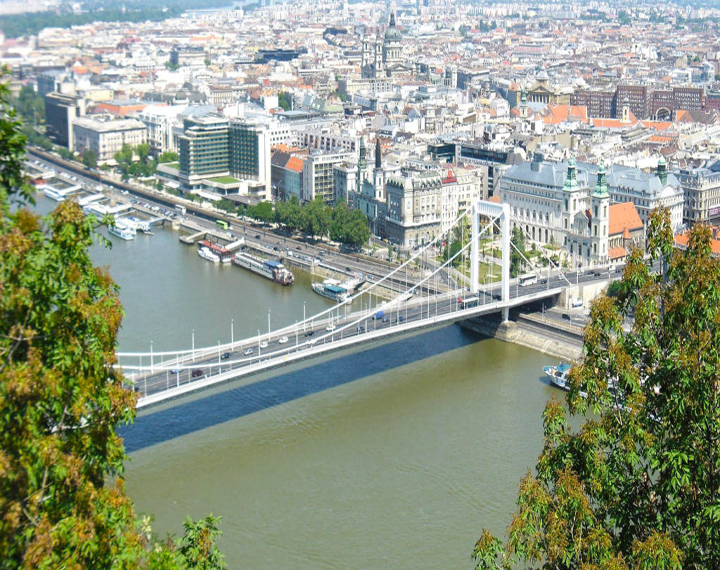
A slender white silhouette of modern grace spanning the Danube with minimalist elegance and historical resilience. The Elisabeth Bridge is one of Budapest’s most recognizable river crossings, connecting the bustling March 15th Square in Pest to the foot of Gellért Hill in Buda. Named after Empress Elisabeth, the beloved “Sisi” of Austria-Hungary, the original bridge was an ornate chain structure completed in 1903, which at the time held the record for the largest span of its kind in the world. After its destruction during the Second World War, it was replaced in 1964 by the current cable-stayed design, standing as the only bridge in the city that was not reconstructed in its original historicist form, but rather as a bold symbol of modern Hungarian engineering.
Culturally, the bridge serves as a poignant reminder of the city’s twentieth-century transformation and the enduring legacy of Queen Elisabeth in the Hungarian heart. While the original bridge was a masterpiece of eclectic decoration, the current structure is celebrated for its clean, functional lines and its brilliant white color, which contrasts beautifully with the deep green of the Liberty Bridge and the stone grandeur of the Chain Bridge. It remains a vital link for the city’s transit and a favorite subject for architects who appreciate the transition from imperial opulence to mid-century minimalism.
* Features a sophisticated cable-stayed system that allows for a vast, unobstructed view of the river and the surrounding UNESCO World Heritage embankments.
* Acts as the primary gateway to the Gellért Hill pathways and the Rudas Baths, one of the city’s most famous Ottoman-era thermal spas.
* The Pest bridgehead is anchored by the Inner City Parish Church, the oldest building in Pest, creating a striking contrast between ancient stone and modern steel.
For tourists, the bridge offers one of the most breathtaking panoramic walks in the capital, particularly when crossing from Pest toward the greenery of Buda. From the center of the span, visitors enjoy a perfectly framed view of the Buda Castle and the Parliament building, making it a premier spot for evening photography. Its location makes it a strategic crossing point for those wishing to transition from the shopping streets of the city center to the hiking trails that lead up to the Citadella.
* Provides wide, well-maintained pedestrian walkways that are separated from the heavy flow of urban traffic, ensuring a comfortable stroll.
* Offers an exceptional vantage point for the annual August 20th fireworks display, where the white cables catch the light of the celebrations.
* The bridge is brilliantly illuminated at night with a specialized lighting system that emphasizes its slender form against the dark river.
The ambiance of the bridge is defined by a sense of airy openness and constant motion, where the river breeze and the rhythmic hum of the city create an invigorating environment. As you walk across, the scale of the Danube feels particularly immense, and the sight of the white pylons reaching toward the sky provides an uplifting sense of modern progress. It is a place that celebrates the forward-looking spirit of Budapest, offering a beautiful and minimalist perspective on a city otherwise defined by its golden imperial history.



 Own or work here?