
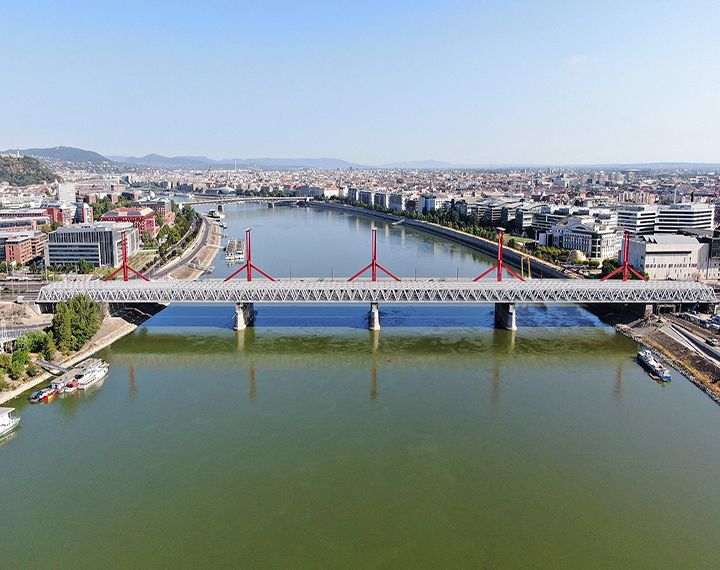
A vibrant crimson silhouette of modern engineering uniting the artistic soul of South Pest with the academic heart of Buda. The Rákóczi Bridge, formerly known as Lágymányosi Bridge, is the southernmost road bridge in Budapest, serving as a striking example of late twentieth-century industrial design. Completed in 1895 and renamed in 2011 to honor the noble Rákóczi family, the bridge was constructed to alleviate the growing traffic of the city while providing a dedicated path for the expanding tram network. Its most defining characteristic is the series of five massive, red-painted pylons equipped with unique mirror-topped illumination masts that reflect light downward, creating a soft, glare-free glow that transforms the structure into a radiant landmark after sunset.
* Features a pioneering mirror-reflector lighting system designed to provide even illumination without obstructing the view of the starry night sky or the river.
* Serves as a vital link for the Tram Line 1, which crosses the Danube here to connect the various districts of the southern capital.
* Positioned directly alongside the iconic Southern Railway Bridge, creating a fascinating juxtaposition of nineteenth-century lattice ironwork and sleek modern aesthetics.
Culturally, the bridge acts as the gateway to the “Millennial Cultural Center,” a sophisticated district on the Pest bank that houses the National Theatre and the Palace of Arts. The bridge’s bold aesthetic reflects the forward-looking spirit of post-communist Hungary, symbolizing a departure from traditional imperial styles toward a functionalist, contemporary identity. It has become a favorite subject for modern architectural photographers who are drawn to its clean lines, vibrant color, and the way its red steel contrasts with the deep blue of the Danube and the lush greenery of the nearby Kopaszi Dam.
* The northern side of the bridge offers an unobstructed view of the stunning glass architecture of the Müpa Budapest and the National Theatre.
* Acts as a primary access point for the Kopaszi-gát, a beautifully landscaped peninsula that has become one of the city’s most popular modern parklands.
* Its wide, separated bicycle and pedestrian paths make it a preferred crossing for cyclists traveling along the international EuroVelo 6 river route.
For tourists, Rákóczi Bridge offers a different perspective of Budapest, away from the dense historical core and toward the expansive, modern reaches of the river. Walking across the bridge at dusk provides a breathtaking vista where the classical silhouettes of the Gellért Hill and the Liberty Bridge are visible in the distance, framed by the crimson pylons of the south. It is an essential stop for those interested in contemporary urban planning, offering a seamless connection between the university campuses of Buda and the world-class concert halls of the Pest embankment.
* Provides a spacious and safe environment for walking, with footpaths that are physically separated from the heavy flow of vehicle traffic.
* Highly accessible via the suburban railway and numerous tram lines, making it a convenient starting point for a riverside stroll toward the Kopaszi Dam.
* The red pylons are equipped with specialized sensors and weather stations, highlighting the bridge’s role as a “smart” piece of urban infrastructure.
The atmosphere of the Rákóczi Bridge is one of energetic motion and airy openness, where the wind from the Danube and the rhythmic hum of passing trams create a sense of modern vitality. As the red light of the pylons reflects off the water, the bridge feels like a living part of the city’s nocturnal pulse, inviting and full of life. It is a place that celebrates the beauty of utility, offering an uplifting experience that reminds every visitor of Budapest’s ongoing journey as a dynamic and evolving European metropolis.



 Own or work here?