

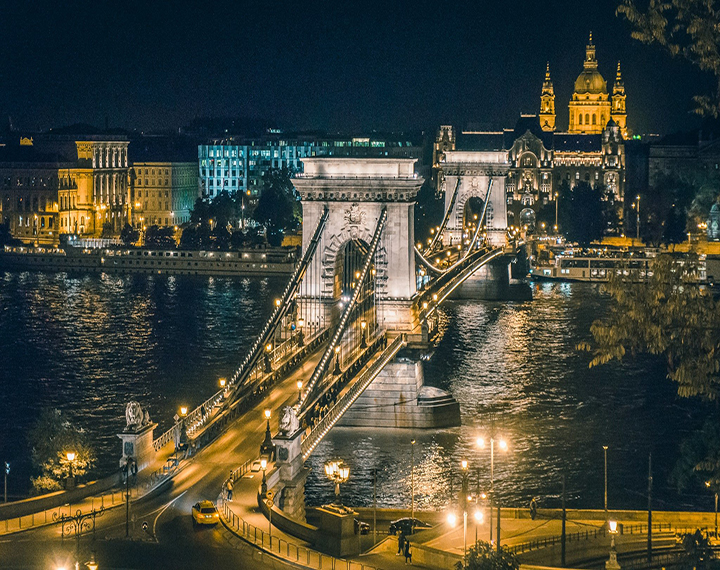
A majestic wrought-iron sentinel spanning the Danube to unite the historic hearts of Buda and Pest. The Széchenyi Chain Bridge stands as the first permanent stone bridge to connect the two sides of the Hungarian capital, serving as a powerful symbol of national awakening and progress. Designed by William Tierney Clark and built by Adam Clark, this engineering marvel opened in 1849 and immediately transformed the city into a unified metropolis. Its classic proportions and triumphant arches represent a turning point in Hungarian history, bridging not just the river but the social and economic divide of the era.
* Features the famous stone lions sculpted by János Marschalkó, which have guarded the bridge abutments since 1852.
* Boasts a sophisticated suspension design that was considered one of the modern world’s engineering wonders at the time of its completion.
* Recently underwent an extensive restoration to preserve its structural integrity while modernizing its decorative lighting.
Cultural significance flows through the bridge as deeply as the river beneath it, appearing in countless works of art, literature, and film as the definitive icon of Budapest. During the 1848-1849 War of Independence, it survived attempts to blow it up, only to be destroyed by retreating troops in World War II and triumphantly rebuilt by 1949. It remains a focal point for national celebrations, often serving as the backdrop for spectacular fireworks and community gatherings that honor the country’s enduring spirit.
* Serves as a vital link between Roosevelt Square in Pest and Adam Clark Square in Buda.
* Symbolizes the transition from a medieval past to a modern European identity.
* Inspired by the Hammersmith Bridge in London, reflecting a shared nineteenth-century architectural ambition.
Tourists find the bridge to be one of the most rewarding walking routes in Europe, offering an intimate perspective of the Danube’s grandeur. Strolling across the pedestrian walkways allows visitors to appreciate the massive iron chains and the intricate classical details of the stone towers up close. It provides the perfect physical and visual transition between the flat, urban energy of the Pest side and the rising, green fortifications of the Buda Castle District.
* Offers a spectacular vantage point for viewing the Hungarian Parliament Building and the Buda Castle simultaneously.
* Becomes an illuminated masterpiece at night, with thousands of lights tracing its elegant silhouette across the water.
* Located within walking distance of the historic funicular and the central tram lines, making it easily accessible from any part of the city.
The experience of crossing the bridge is often accompanied by the vibrant life of the riverbanks, where seasonal markets and street performers add a layer of contemporary charm to the historical setting. Many visitors choose to begin their exploration of the city here, using the bridge as a compass to navigate between the imperial grandeur of the west bank and the cultural pulse of the east. It is a place where history feels tangible, and the beauty of the landscape is perfectly framed by human ingenuity.



 Own or work here?