

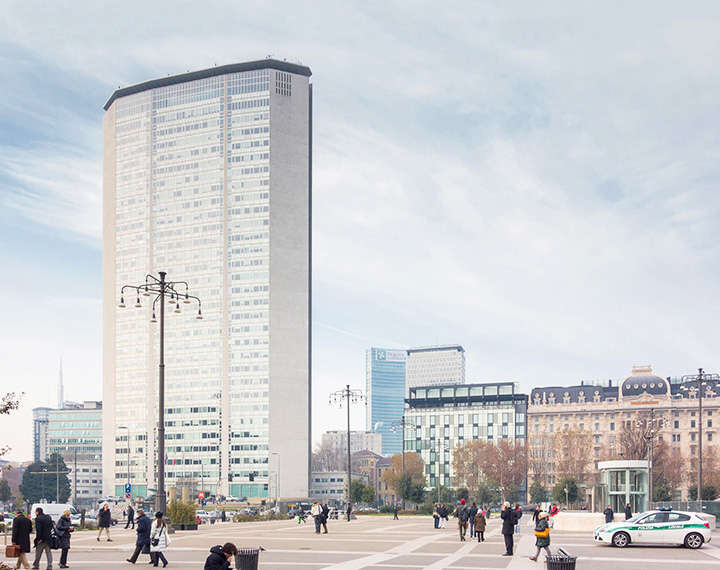
A landmark of modernist architecture, once one of Italy’s tallest skyscrapers and a symbol of Milan’s economic power. Pirelli Tower (also known as Grattacielo Pirelli or affectionately “il Pirellone” – “the Big Pirelli”) is one of Milan’s most iconic modernist skyscrapers and a symbol of the city’s post-war economic boom and architectural innovation. Designed by the celebrated architect Gio Ponti in collaboration with structural engineer Pier Luigi Nervi (and a team including Alberto Rosselli and others), construction began in 1956 and was completed in 1960. Rising to 127 meters (417 ft) with 31–32 floors (including 2 basement levels), it was Italy’s tallest building from 1960 until 1995 and remains one of the country’s most elegant high-rises.
Its slender, tapered form—curved at the base and top, with a distinctive aluminum-clad façade and vertical emphasis—breaks from the boxy American skyscraper model, instead drawing inspiration from nautical design and Italian elegance. The structure uses innovative reinforced concrete techniques by Nervi, allowing for open floor plans and a lightweight yet strong profile. Located at Piazza Duca d’Aosta 2, 20124 Milano (right opposite Milano Centrale railway station in the bustling Stazione Centrale district), the Pirellone was originally the headquarters of the Pirelli tyre company, embodying Milan’s industrial power and modernity.
A small golden Madonnina statue tops the building (a nod to the Duomo’s famous spire), marking it as the first structure in Milan to surpass the cathedral’s height. Since the early 2000s, it has housed offices for the Lombardy Region government, serving as the seat of the regional presidency and council. The tower’s sleek, sculptural design—often praised for its grace, proportions, and innovative use of materials—has made it a landmark of mid-20th-century Italian modernism, frequently featured in architectural histories and admired for redefining skyscraper aesthetics in Europe.



 Own or work here?