

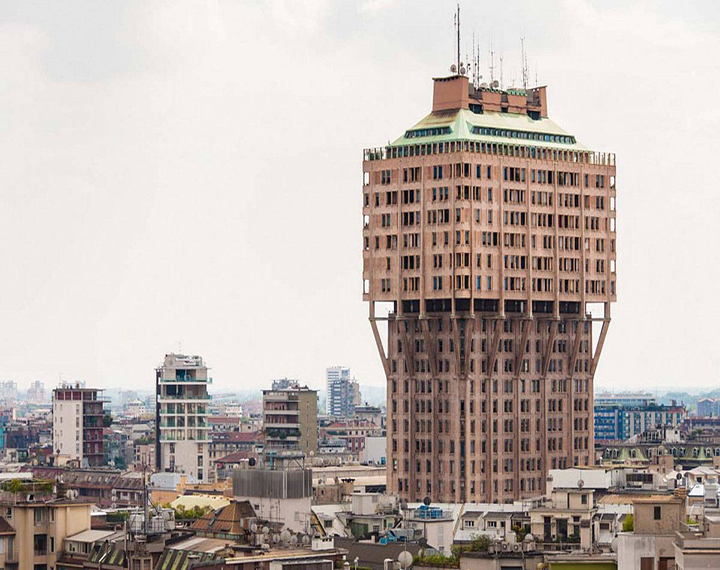
One of Milan’s most iconic and debated skyscrapers. Torre Velasca (Velasca Tower) is one of Milan’s most iconic and debated skyscrapers, a landmark of post-war Italian architecture that has recently undergone a major renovation to reconnect it with the city. Designed by the renowned BBPR architectural partnership (Banfi, Belgiojoso, Peressutti, and Rogers) and completed in 1958, the 106-meter-tall tower rises 26 stories (sometimes counted as 29 including base levels) in the heart of historic Milan at Piazza Velasca 5, 20122 Milano, near Piazza Missori and just a short walk from the Duomo.
Its distinctive “mushroom” or “inverted pyramid” shape—slender lower floors that dramatically flare out into a wider upper section—has earned it the affectionate Milanese nickname “la torre con le bretelle” (the tower with braces), evoking the look of a building wearing suspenders. This form was innovative for its time: the narrower base respects the scale of surrounding historic streets and buildings, while the cantilevered upper floors maximize office space and offer panoramic views.
The tower blends modernist principles with contextual sensitivity to Milan’s Gothic and medieval heritage, standing out amid the city’s domes and spires. It was one of the first significant high-rises built after World War II during Milan’s reconstruction boom, symbolizing renewal and modernity. Over the decades, opinions have varied—some call it brutalist or even “ugly,” while others praise its bold, sculptural presence as a masterpiece. Following a comprehensive restoration led by Hines (in collaboration with Asti Architetti and others), the tower reopened in 2025 as a mixed-use development.
The project transformed it from a gated office building into a more accessible, vibrant hub: it now includes premium offices, luxury residences (branded apartments), retail spaces, a public piazza at the base for community events, and enhanced ground-level connectivity. The renovation preserved the original copper-clad roof and concrete structure while updating interiors for contemporary standards, emphasizing sustainability, openness, and urban integration. Today, it’s a protected cultural heritage site and a key part of Milan’s evolving skyline, blending mid-century heritage with modern luxury living and public space.



 Own or work here?