
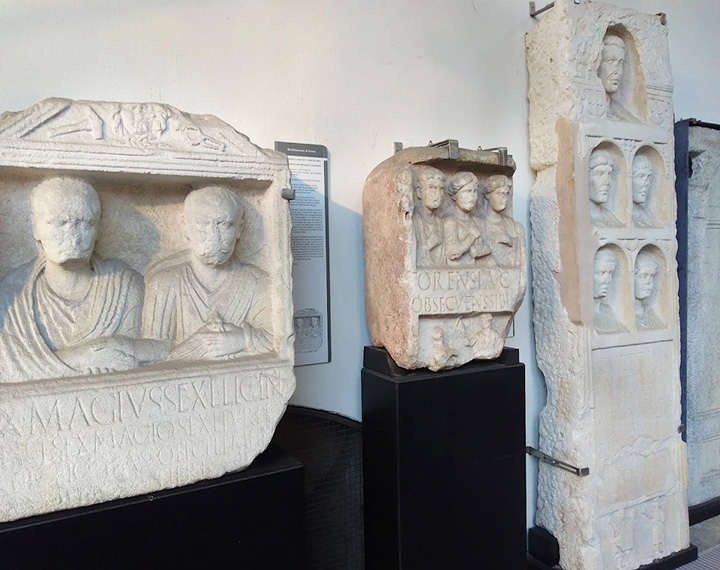
The Civic Archaeological Museum of Milan is housed in the remarkable setting of the former Monastero Maggiore convent, attached to the historic church of San Maurizio al Monastero Maggiore. Founded in the 19th century as the successor to earlier collections, including the Museo Patrio Archeologico established in 1862, the museum preserves and displays artifacts that trace the ancient history of Milan and beyond. Its location incorporates visible Roman structures, such as parts of city walls, towers from a late Roman circus, and remains of a domus, allowing visitors to experience archaeology in situ while exploring the broader cultural heritage.
The museum’s collections cover a wide range of ancient civilizations, with dedicated sections for Roman Milan, Greek, Etruscan, early medieval, and Gandharan art. Highlights include exceptional Roman pieces like the intricate Diatreta Trivulzio cup and the luxurious Patera di Parabiago, alongside Greek pottery, Etruscan objects illustrating daily life and religion, and early medieval items from Gothic and Lombard traditions. The Gandharan section features notable Buddhist sculptures from ancient Pakistan and Afghanistan, showcasing cross-cultural artistic influences. These exhibits provide a comprehensive view of societal, religious, and artistic developments across centuries.
Through its thoughtfully arranged displays and recent expansions, the museum offers an engaging journey into Milan’s ancient past, from its Celtic origins through Roman prosperity to the transition into the early Middle Ages. It emphasizes not only local history but also connections to distant cultures, making it a key resource for understanding Mediterranean and Eastern ancient worlds. The peaceful cloister setting enhances the contemplative experience of discovering these enduring testimonies of human civilization.



 Own or work here?