

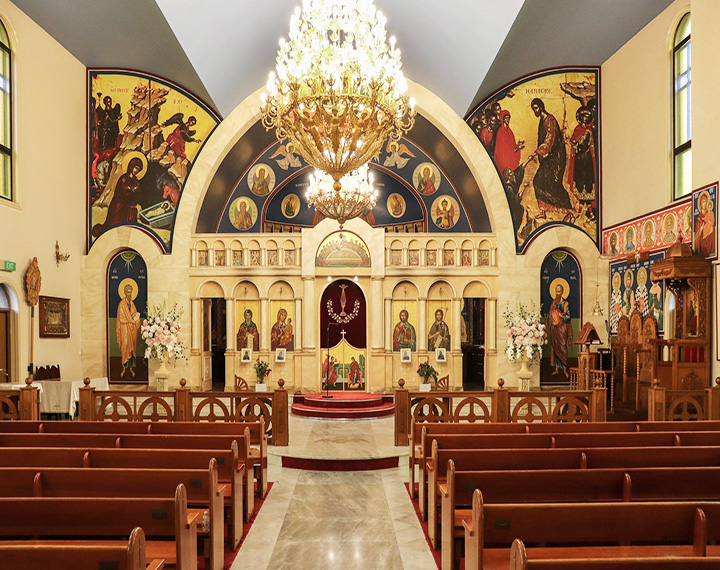
Also known as the Greeko-Orthodox Cathedral of Sts. Constantine and Helen, this historic church in Johannesburg was built in 1912 and opened in 1913. The building was designed by Hermann Kallenbach in a Byzantine style, with white walls and a beautifully domed ceiling painted blue on the inside. It serves as a heritage landmark, reflecting the city’s once-thriving Greek Orthodox community. The Greek Orthodox Cathedral of Saints Constantine and Helen stands as a radiant symbol of faith, heritage, and spiritual continuity, honouring two of the most revered figures in Orthodox Christianity. Saint Constantine the Great, remembered for granting religious freedom to Christians through the Edict of Milan, is celebrated as a protector of the Church and a pivotal force in shaping the Christian world. His mother, Saint Helen, is cherished for her profound devotion and for her pilgrimage to Jerusalem, during which she is believed to have discovered the True Cross. Together, their lives form a story of faith, courage, and divine purpose, inspiring Orthodox believers across generations.
Cathedrals bearing their name—whether in Brooklyn, Honolulu, Merrillville, or elsewhere in the world—serve as spiritual sanctuaries for Greek Orthodox communities and as cherished cultural anchors for the wider diaspora. These sacred spaces are often designed in the majestic Byzantine tradition, with domes, rich iconography, and golden light that fills the nave with a sense of reverence. Within these walls, prayer, tradition, and community flow together, creating a place where ancient rituals are carried forward with unwavering devotion.
Beyond their architectural beauty, these cathedrals embody the heart of Orthodox life. They offer not only worship, but also fellowship, education, and cultural preservation. Families gather for feast days, festivals, and sacraments; children learn the language, history, and values of their ancestors; and visitors from all backgrounds are welcomed into a spirit of hospitality deeply rooted in Hellenic tradition. They stand as places where faith is lived, celebrated, and passed lovingly from one generation to the next.



 Own or work here?