

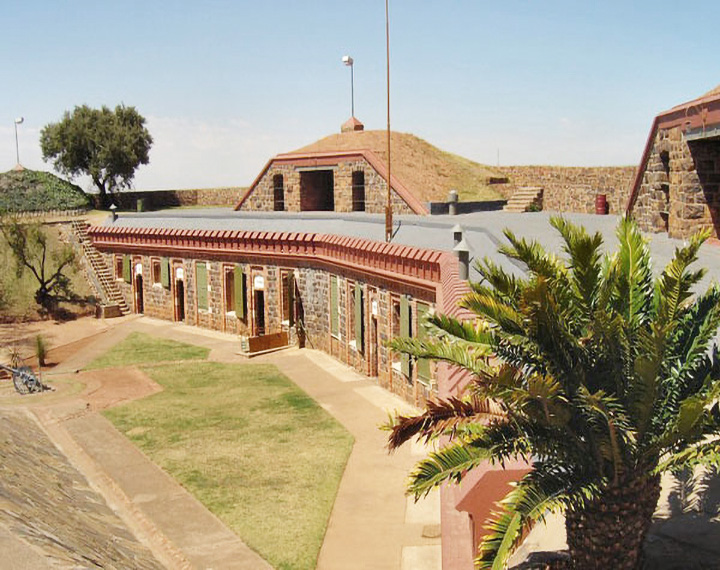
Fort Klapperkop stands as a striking relic of late 19th-century military engineering, perched on a hilltop in Pretoria’s Groenkloof Nature Reserve, just a short drive from Johannesburg. Constructed in 1898 by the German firm Krupp under designs by engineers von Dewitz and Werner, it formed part of a ring of four forts built by the South African Republic to safeguard its capital against impending British invasion during the escalating tensions leading to the Second Anglo-Boer War. The fort’s pentagonal layout, reinforced concrete walls, and strategic positioning allowed for all-around artillery fire, equipped originally with a formidable 155mm Creusot “Long Tom” cannon, though these heavy weapons were later relocated. Surrounded by a distinctive dry moat—too porous to hold water—and accessible via a drawbridge, it featured advanced innovations for the era, including a paraffin-powered generator for electric lighting and searchlights, overhead telegraph lines for communication, and even lightning conductors to protect against storms. Named after the indigenous Strychnos pungens tree, or “klapperkop,” that dots the surrounding hills, the structure never fired a shot in battle, as British forces bypassed it during their advance in 1900, leaving it lightly manned and ultimately abandoned.
Today, Fort Klapperkop serves as a meticulously restored museum and Gauteng Provincial Heritage Site, offering visitors an immersive glimpse into South Africa’s turbulent military past from the mid-1800s through the Anglo-Boer War. Inside, exhibits showcase period artifacts like rifles, uniforms, and soldier quarters, recreating the austere living conditions of the garrison’s original 18-man crew, while outdoor displays include a vintage steam locomotive used for troop transport, Pretoria’s last surviving tram, and a poignant memorial statue honoring South African Defence Force veterans. Beyond its historical allure, the site blends seamlessly with the natural landscape, providing panoramic vistas of the Jacaranda-lined city below, alongside hiking trails, mountain biking paths, and opportunities for wildlife spotting amid grazing zebras and wildebeest. This harmonious fusion of defense heritage and outdoor recreation makes it an ideal day trip for those exploring the Gauteng region’s layered history, underscoring how a symbol of conflict has evolved into a space for reflection and leisure.



 Own or work here?