

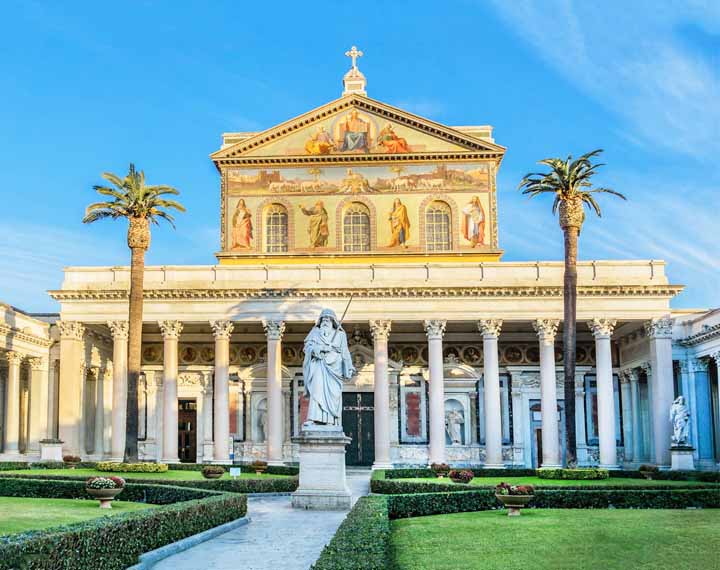
The Basilica of Saint Paul Outside the Walls, A timeless sanctuary uniting faith, history, and transcendent Roman artistry is one of Rome’s four major papal basilicas and a site of profound historical and spiritual resonance. Standing along the ancient Via Ostiense, it marks the burial place of Saint Paul the Apostle, whose tomb lies beneath its high altar. The original church was founded by Emperor Constantine in the 4th century, soon after Christianity was legalized in the Roman Empire. Over the centuries, it has been expanded and restored, especially after a devastating fire in 1823, which led to its grand 19th-century reconstruction that preserved its early Christian plan and grandeur.
Stepping inside, visitors are greeted by a vast interior that evokes awe and reverence. Marble columns line the immense nave, supporting gilded ceilings and mosaics that shimmer in golden light. Portraits of all popes since Saint Peter adorn the upper walls, symbolizing the unbroken continuity of the papacy. The apse mosaic, depicting Christ surrounded by saints, remains one of the most majestic in Rome, a masterpiece that connects faith, art, and eternity. Beneath the floor lies Saint Paul’s sarcophagus, visible through a glass case, drawing pilgrims from around the world to kneel and reflect at the resting place of one of Christianity’s most influential figures.
The basilica’s cloister is a hidden treasure, a 13th-century masterpiece of medieval art with elegant twisted columns, intricate mosaics, and a peaceful garden bathed in sunlight. Here, time seems suspended, offering a quiet refuge from the bustle of Rome. The surrounding area retains a sense of sacred calm, far from the tourist crowds, making it a destination where faith, history, and architectural beauty intertwine.

The Constantinian basilica … In the year 313 the emperor Constantine proclaimed freedom of worship, putting an end to the persecution of Christians. He had basilicas built over the tombs of Peter and Paul. Pope Sylvester consecrated St Paul’s around the year 330. The small dimensions of the building were due to the limitations of the space available. The basilica faced east towards Jerusalem and was bounded on that side by a cliff and by the ancient Via Ostiensis.
And the great Theodosian basilica of the fourth century. Given the rapid increase in the number of pilgrims, the need to expand the capacity of the building, the difficulty of simply enlarging it and the impossibility of moving the tomb, the three emperors then reigning, Theodosius, who in 391 would proclaim Christianity the state religion, Valentinian II and Arcadius, built what was then the largest basilica in Rome. It faced west and was consecrated by Pope Siricius in the year 390
A building of impressive and beautiful proportions because it brings together ancient, very valuable remains. The entrance to this church produces a solemn effect: mighty rows of columns support large frescoed walls, closed at the top by the wooden interweaving of the roof; so that our ill-accustomed eye receives at first almost the impression of a barn, although the whole, if the lintel were covered with carpets during the holidays, would produce an incomparable vision.



 Own or work here?