

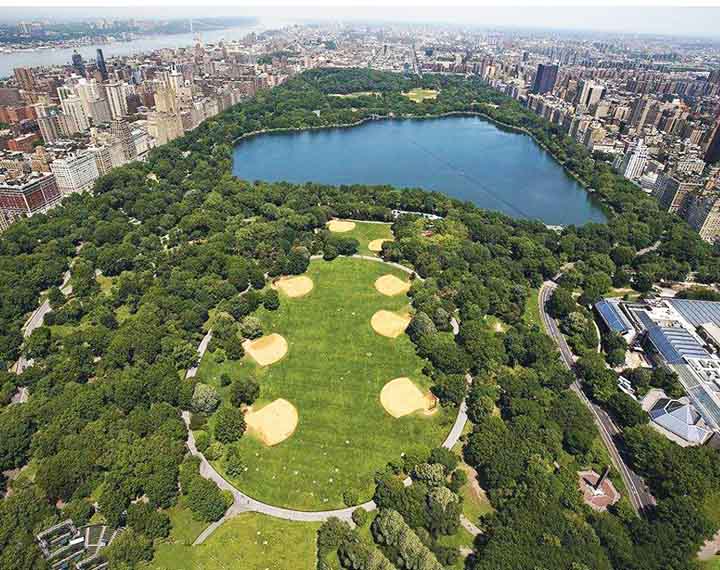
The Great Lawn in Central Park is one of New York City’s most beloved cultural and recreational treasures, a vast green expanse that embodies the city’s communal spirit and its enduring love of open space. Stretching between 79th and 85th Streets, this 55-acre oval field was not always the lush sanctuary it is today. In the 19th century, the site served as the Croton Reservoir, which supplied the growing metropolis with fresh water. When the reservoir was demolished in the 1930s, landscape architects reshaped the area into a grand open lawn, symbolizing renewal and the city’s commitment to public beauty during the Great Depression. Over the decades, it has evolved into a place where the everyday life of New Yorkers and visitors converges — where children play, couples picnic, and athletes fill the air with laughter and friendly competition.
Historically, the Great Lawn has mirrored the social and cultural evolution of New York itself. In the 1960s and 70s, it became an emblem of the countercultural movement, hosting gatherings, peaceful protests, and impromptu performances. In later years, it transformed into one of the world’s most celebrated outdoor concert venues, graced by the New York Philharmonic, Simon & Garfunkel, Elton John, Diana Ross, and countless others. Each performance, whether classical or contemporary, has carried the echo of the city’s collective heartbeat, turning the open field into a natural amphitheater beneath the Manhattan skyline. The Great Lawn’s carefully maintained grass, framed by ancient elms and skyline views, serves as a living reminder of how nature and urban life can exist in harmony.
For tourists, the Great Lawn offers not just relaxation but also connection — to art, to history, and to the spirit of New York. Sitting there at sunset, watching the city’s towers shimmer beyond the trees, one senses the democratic beauty of Central Park: a space open to all, where music, laughter, and history linger in the breeze. It is a place where the ordinary moments of daily life are elevated by the extraordinary backdrop of the city that never sleeps. Located at the precise geographical center of Central Park is one of the most well-known lawns in the world: the Great Lawn. The 55-acre area hosts a great range of recreational activities and is a popular destination for picnicking, sunbathing, relaxing, playing and watching softball, and enjoying the scenery. The main oval lawn area is 12 acres and includes six fields for softball. (Heckscher Ballfields and the North Meadow are home to the Park’s other sports fields). All require a permit to play organized games. To the north of the main lawn are two additional fields for volleyball and basketball.
The Great Lawn is well-known as a place for concerts and performances, hosting the annual New York Philharmonic Concerts in the Parksperformance and annual Global Citizen Festival. The Great Lawn landscape also includes important scenic destinations such as the Arthur Ross Pinetumand Turtle Pond. Although it may resemble some of Central Park’s other famous lawns such as Sheep Meadow, the Great Lawn is a relatively recent addition to the Park. It was built in the 1930s to replace a large reservoir that pre-dated Central Park, once a key piece of the City’s water distribution system. Completed in 1842, the receiving reservoir was a huge stone tank for holding water from upstate New York before it was piped further downtown. When planning for the Park began, a new reservoir was created just to the north, now known as the Jackie Kennedy Onassis Reservoir, in order to expand the system. Both reservoirs posed an obstacle to Park designers.



 Own or work here?