

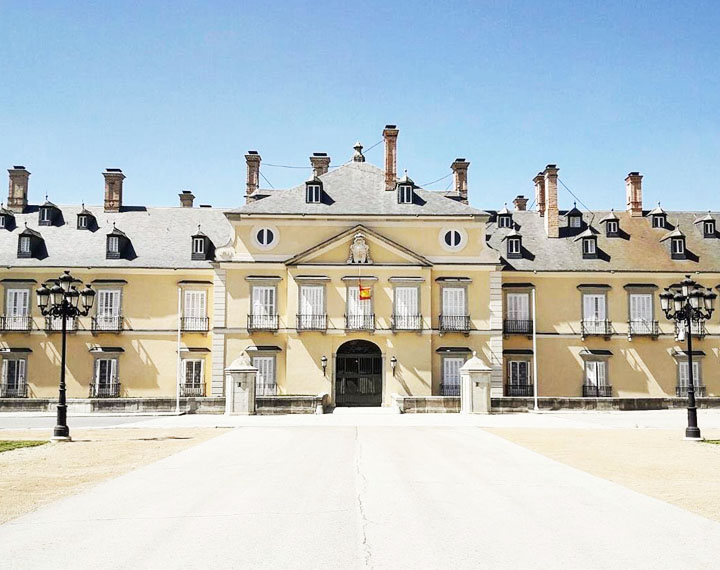
The Royal Palace of El Pardo has been the Official Residence for Foreign Heads of State since 1983 and its origins as a royal hunting lodge are linked to the El Pardo hills. It is a building with close ties to the history of Spain. It was built by Emperor Charles V in the 16th century and extended in the 18th century by order of Charles III. It is worth mentioning its surroundings, as it stands on the hill of El Pardo, a natural area of extraordinary value, considered to be the largest Mediterranean forest in the Community of Madrid.
The El Pardo Royal Palace (Palacio Real de El Pardo) is a magnificent royal residence situated just north of Madrid, enveloped by the lush forests of Monte de El Pardo. Originally commissioned in the 15th century by King Henry III of Castile as a royal hunting lodge, the site’s tranquil surroundings made it an ideal retreat for Spanish monarchs seeking peace and solitude. Over the centuries, successive kings expanded and embellished the palace, transforming it from a modest hunting pavilion into a grand architectural masterpiece that reflects the evolution of Spanish royal taste and power.
During the reign of King Charles V in the 16th century, the palace was redesigned by the architect Luis de Vega, incorporating elements of Renaissance design that added elegance and proportion to its structure. Later, under King Charles III, El Pardo was lavishly redecorated and adorned with exquisite frescoes, tapestries, and furniture, much of which remains preserved today. The interior is a treasure trove of Spanish artistry, featuring works by great painters such as Goya and Velázquez, as well as tapestries produced by the Royal Tapestry Factory in Madrid. Each room reflects a chapter in Spain’s royal story, offering visitors a vivid sense of continuity and tradition.
The palace’s location within the Monte de El Pardo, one of Europe’s oldest and most ecologically rich hunting grounds, adds to its allure. The vast forested area, once reserved exclusively for the royal family, is home to deer, wild boar, and numerous bird species. Its natural beauty has made El Pardo a cherished retreat for centuries, blending royal grandeur with the serenity of nature. This harmony between architecture and landscape gives the palace an almost timeless quality—a sanctuary where history and nature coexist in perfect balance.
Today, El Pardo Royal Palace serves an important diplomatic function as the official residence for foreign heads of state visiting Spain. Managed by Spain’s National Heritage organisation, it remains both a historical monument and a working royal residence. Visitors can explore its opulent halls, royal chambers, and art-filled galleries, each preserving the elegance of Spain’s golden age. More than a relic of the past, El Pardo continues to embody Spain’s enduring spirit of hospitality, refinement, and cultural splendour—a palace that lives and breathes the legacy of the Spanish Crown.



 Own or work here?