

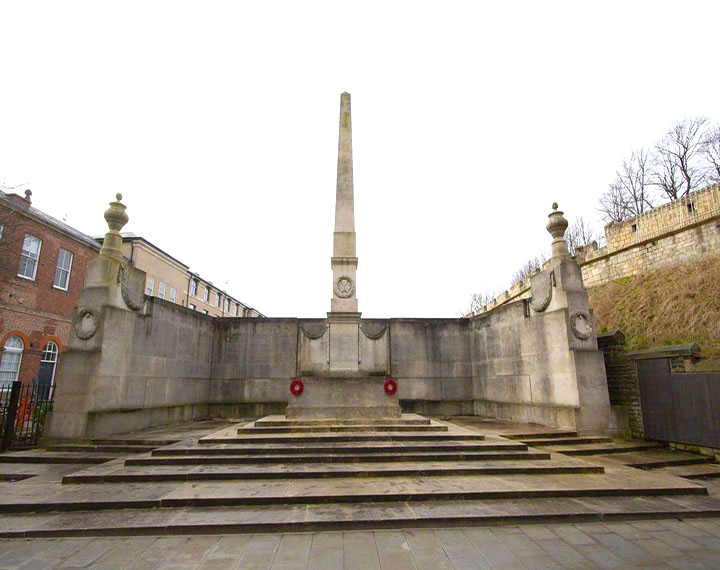
This remarkable memorial was designed by the celebrated architect Sir Edwin Lutyens, who is perhaps best known for designing The Cenotaph in London and many other poignant war memorials across the UK and beyond. Commissioned by the NER board in early 1920, the memorial was unveiled on 14 June 1924 by Field Marshal Lord Plumer. Lutyens’ design is truly distinctive: it features a soaring 54-foot (16-metre) high obelisk of Portland stone, rising from the rear of a three-sided screen wall. Within the recess formed by this wall stands Lutyens’ characteristic Stone of Remembrance, an altar-shaped block found in many Commonwealth War Graves Commission cemeteries, inviting quiet contemplation. The memorial holds a Grade II listed status*, signifying its exceptional national architectural and historical importance.
The memorial originally commemorated the staggering 2,236 men of the North Eastern Railway who tragically gave their lives during the First World War. Their names were meticulously incised into the Portland stone screen walls. Later, in 1984, the memorial was rededicated to also include the 551 London and North Eastern Railway (LNER) men from the former NER area who fell during the Second World War; their names are inscribed on 15 slate panels set into the raised pavement behind the Stone of Remembrance. Over time, the original stone inscriptions have suffered from erosion, making them difficult to read. To ensure these brave names are never forgotten, bronze plaques were affixed to an adjacent retaining wall in 2011, providing a clear and enduring record. The names are also preserved in a “Book of Remembrance” held at the National Railway Museum nearby.
Despite, or perhaps because of, the passage of time and the weathering of its stone, the North Eastern Railway War Memorial remains an incredibly powerful and evocative place of remembrance. It is more than a list of names; it is a tangible link to the lives and sacrifices of thousands of railway workers who left their vital roles to serve their country. Its prominent location, next to the company’s former headquarters and within the city’s rich railway landscape, ensures that their legacy continues to be honoured and remembered by all who pass by.



 Own or work here?