

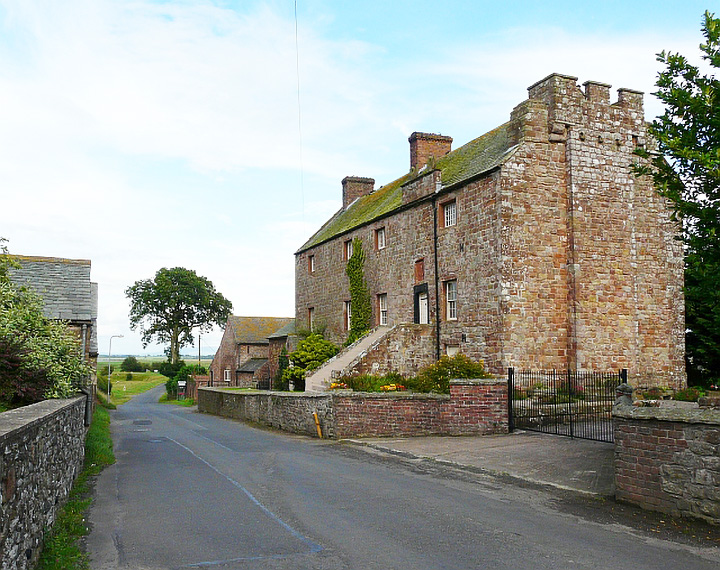
Drumburgh Castle is a historic fortified house, or pele tower, located in the village of Drumburgh, Cumbria, England. It sits near the Solway Firth, about 9 miles northwest of Carlisle, along the road between Bowness-on-Solway and Burgh-by-Sands.
The original structure was built around 1307 by Robert le Brun, who received royal permission to fortify his home. The tower was constructed using red sandstone taken from nearby Hadrian’s Wall, linking it to the area’s Roman past. In 1518, Thomas Dacre renovated the building, turning it into what was described as “neither castle nor tower but a house of strength.” Later, between 1678 and 1681, John Aglionby made further alterations to shape the castle’s current appearance. Unique features include the Dacre family coat of arms on the doorway and parts of a Roman shrine built into the stonework.
Architecturally, Drumburgh Castle is made from squared red sandstone with a steep greenslate roof, decorative carved stone eagles above the entrance, and a mix of window styles that reflect its long history. It has three stories and five bays, plus a single-storey extension and a 19th-century porch. The building’s design blends medieval defensive features with the look of a substantial residence.
Strategically, the castle was built to defend against Scottish border raids and control important crossing points near the Solway Firth. Its use of Roman materials also highlights the area’s long military importance.
Today, Drumburgh Castle remains a private home and is not open for public tours, but it can be admired from the nearby road. The surrounding area, including the neighboring village of Burgh by Sands, is rich in history, with other sites reflecting the region’s Roman and medieval past.
https://historicengland.org.uk/listing/the-list/list-entry/1144623



 Own or work here?