

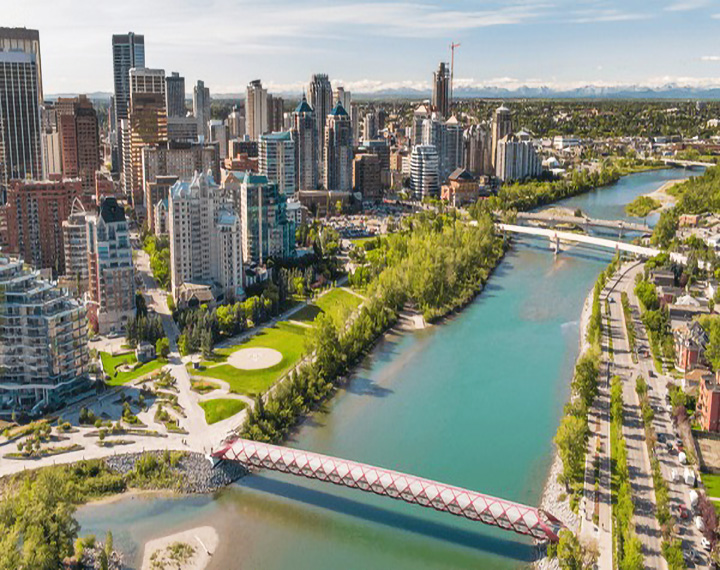
The Bow River is a defining natural landmark that flows through Calgary, Alberta, offering scenic beauty and recreational opportunities. Originating from Bow Lake in the Canadian Rockies, it travels southeast through Banff National Park, Canmore, and the city of Calgary before merging with the Oldman River to form the South Saskatchewan River. Its journey shapes the geography and culture of the region.
In Calgary, the Bow River is central to outdoor activities. Its clear waters are popular for kayaking, canoeing, and paddleboarding, with several access points catering to adventurers. Anglers are drawn to the river for its world-class trout fishing. The banks of the Bow are home to a network of pathways, including the Bow River Pathway, which is widely used by cyclists, joggers, and walkers. These trails connect various neighborhoods and parks, promoting an active and vibrant community.
Several bridges span the Bow River in Calgary, such as the Peace Bridge and the George C. King Bridge, adding architectural charm and accessibility to the city. Parks like Prince’s Island Park and St. Patrick’s Island are situated along its course, providing green spaces for picnics, festivals, and relaxation.
The Bow River also holds ecological significance. It supports diverse wildlife, including birds, fish, and mammals, and plays a vital role in Calgary’s water supply and environmental health. Efforts to preserve its ecosystem have led to initiatives promoting clean water and sustainable practices.
As a symbol of Calgary’s natural heritage, the Bow River enriches the city with its beauty, recreation, and cultural significance, making it a cherished feature for residents and visitors alike.



 Own or work here?