

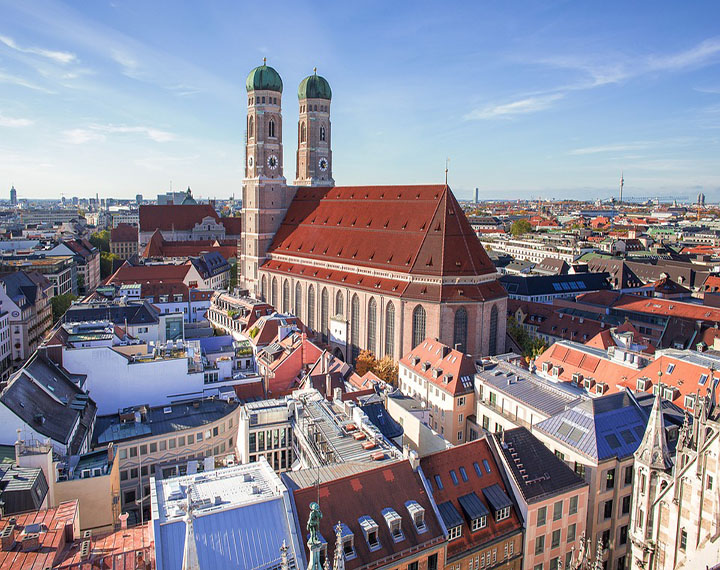
2 towers top this restored Gothic church, bombed in 1945, known for its legendary Devil’s footprint. The Frauenkirche, or Cathedral of Our Dear Lady, is one of Munich’s most iconic landmarks and a symbol of the city. Built in the Gothic style, the Frauenkirche features distinctive red brickwork and twin towers that dominate the Munich skyline. The church’s hallmarks are its characteristic domes, which earned it the nickname “Dome of Munich” or “Cathedral of Our Lady”.
Construction of the Frauenkirche began in 1468 under the patronage of Duke Sigismund of Bavaria and was completed in 1488. Despite suffering damage during World War II, the church was meticulously restored to its former glory in the post-war years. The interior of the Frauenkirche is equally impressive, with high vaulted ceilings, intricate stone carvings, and beautiful stained glass windows. Notable features include the ornate high altar, the tomb of Emperor Ludwig IV, and the crypt housing the remains of prominent figures from Bavarian history.
According to local folklore, the architect of the Frauenkirche made a pact with the devil to finance the construction of the church. In exchange, the devil demanded that there be no windows in the building. However, the clever architect designed the church in such a way that the columns obstruct the view of the windows from the entrance, thus outsmarting the devil. Legend has it that the devil left behind a footprint in frustration, which can still be seen in the church today.
The Frauenkirche is open to visitors and offers guided tours that provide insight into its history, architecture, and significance. Visitors can also attend religious services, concerts, and cultural events held within the church.
Overall, the Frauenkirche is not only an architectural marvel but also a symbol of resilience, faith, and cultural heritage in Munich.



 Own or work here?