


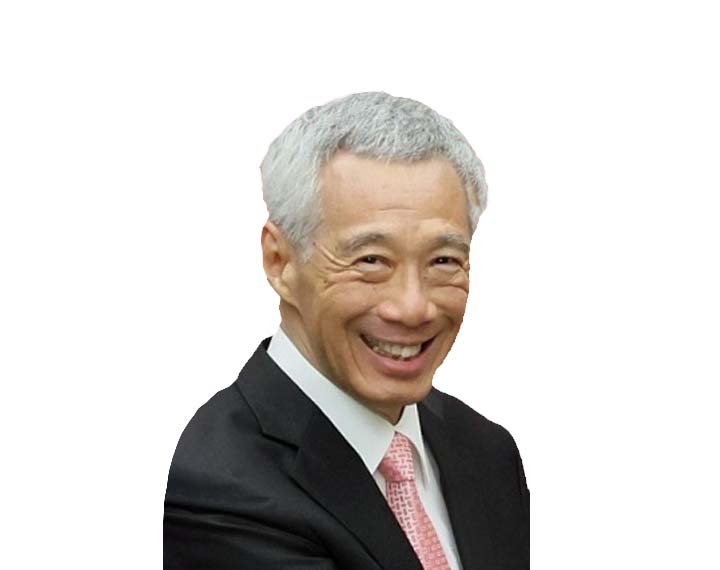
Prime Minister Lee Hsien Loong
Prime Minister since 12 August 2004. Lee Hsien Loong (Chinese: 李显龙; pinyin: Lǐ Xiǎnlóng; born 10 February 1952) is a Singaporean politician and former brigadier-general who has been serving as Prime Minister of Singapore and Secretary-General of the People’s Action Party since 2004. He has been the Member of Parliament (MP) representing the Teck Ghee division of Ang Mo Kio GRC since 1991, and previously Teck Ghee SMC between 1984 and 1991.
Born in Singapore during British colonial rule, Lee is the eldest son of Singapore’s first prime minister, Lee Kuan Yew. He graduated from Trinity College, Cambridge in 1974 with a Bachelor of Arts with first class honours degree in mathematics and a diploma in computer science (now equivalent to a master’s degree in computer science) with distinction. He also completed a Master of Public Administration degree at Harvard Kennedy School in 1980. He served in the Singapore Armed Forces (SAF) between 1971 and 1984, and attained the rank Brigadier-General before entering politics in 1984 where he was elected as the Member of Parliament (MP) for Teck Ghee SMC and since its dissolution in 1991, he has been representing the Teck Ghee ward of Ang Mo Kio GRC.
Lee had served as Deputy Prime Minister, Minister for Finance, Minister for Trade and Industry and Second Minister for Defence under Prime Ministers Lee Kuan Yew and Goh Chok Tong before assuming the office of Prime Minister in 2004. In his first two years, his government enacted a “five-day work week” and extended maternity leave days. His proposal to build two Integrated Resorts (IRs) in Singapore to increase tourism revenue led to the development of the Marina Bay Sands and Resorts World Sentosa. Following the Great Recession, he oversaw the country’s economic recovery within two years. Further political reforms in 2010 saw increased online activism as well as the number of Non-Constituency Members of Parliament (NCMPs) in Parliament. Lee is frequently noted by the international media as the world’s highest paid state leader. His libel suits against journalists and political opponents have been frequently covered by international news outlets.
The prime minister of Singapore is the head of government of the Republic of Singapore. The president appoints the prime minister, a Member of Parliament (MP) who in their opinion, is most likely to command the confidence of the majority of MPs. The incumbent prime minister is Lee Hsien Loong, who took office on 12 August 2004.
Singapore is modelled after the Westminster system. The prime minister only governs with the confidence of the majority in Parliament; as such, the prime minister typically sits as a Member of Parliament (MP) and leads the largest party or a coalition of parties. In practice, the prime minister is the leader of the political party with the majority number of elected MPs.
The Prime Minister’s Office (PMO) comprises seven agencies and three statutory boards that support and advise the Prime Minister.
The agencies operate independently and each reports to its own Accounting Officer.
The statutory boards are the Monetary Authority of Singapore (MAS) and the Civil Service College (CSC). MAS is the central bank of Singapore. Its mission is to promote sustained non-inflationary economic growth, and a sound and progressive financial centre. MAS has its own governing Board, chaired by Senior Minister Tharman Shanmugaratnam. The Civil Service College is the central learning institution for the Singapore Public Service. It operates under the purview of the Public Service Division, Prime Minister’s Office.
The Government of Singapore is defined by the Constitution of Singapore to mean the executive branch of the state, the Republic of Singapore, which is made up of the president and the Cabinet. Although the president acts in their personal discretion in the exercise of certain functions as a check on the Cabinet and the Parliament, their role is largely ceremonial. It is the Cabine
Rate us and Write a Review
 Open Now~08:30 - 17:30
- Saturday08:30 - 17:30
- Monday08:30 - 17:30
- Tuesday08:30 - 17:30
- Wednesday08:30 - 17:30
- Thursday08:30 - 17:30
- Friday08:30 - 17:30


 Own or work here?
