

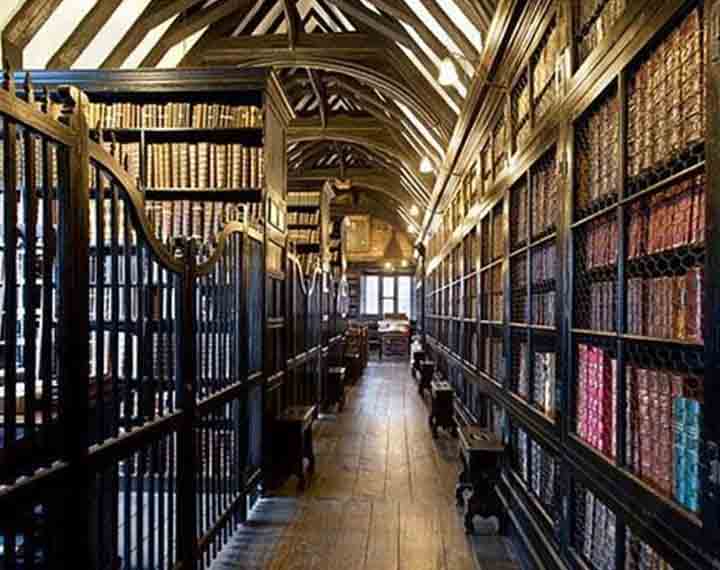
Believed to be the oldest public library in the English-speaking world, this cultural gem with furniture and fittings dating back to 1654 is housed within a stunning sandstone building dating from 1421. Filled with ancient books and dark, panelled rooms, it’s just one of Manchester’s many historic libraries, with the Victorian Gothic John Ryland Library and Portico Library also well worth a visit when in the city centre.
Chetham’s Library in Manchester stands as the oldest free public reference library in the English-speaking world, established in 1653 through the generous bequest of Humphrey Chetham, a prosperous Lancashire merchant and philanthropist. Housed within a beautiful medieval sandstone building dating back to 1421, originally constructed as a college for priests attached to Manchester’s Collegiate Church, the library has remained in continuous use for over 350 years. Its founding vision was to provide free access to knowledge for scholars, clergy, and the public, creating a dedicated space for study and learning in northern England at a time when such resources were scarce outside elite institutions.
The library’s historic interiors feature original oak book presses and reading benches, where early collections included chained books to prevent theft, reflecting the careful preservation methods of the 17th century. Over the centuries, it has amassed more than 100,000 printed volumes, rare manuscripts, archives, and other materials, many designated for their national and international significance. Notable visitors, including Karl Marx and Friedrich Engels, once studied here while developing their ideas, adding to its reputation as a quiet haven for intellectual pursuit amid the bustling city.
Today, Chetham’s Library operates as an independent charity and accredited museum, welcoming visitors from around the world to explore its timeless atmosphere and rich holdings. Nestled near Manchester Cathedral and alongside Chetham’s School of Music, the site blends centuries of history with ongoing cultural importance. It continues to embody the enduring ideal of open access to learning, preserving a remarkable legacy of scholarship and community benefit in the heart of Manchester.



 Own or work here?