

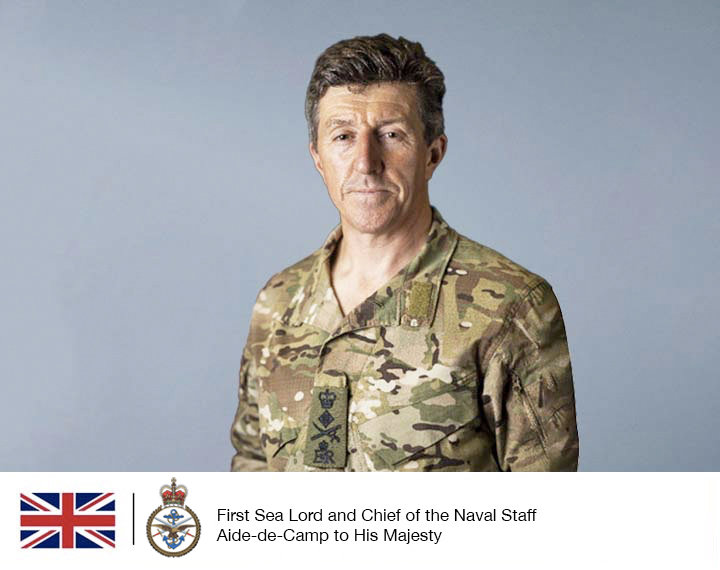
Sir Gwyn Jenkins commissioned into the Royal Marines in 1990. His time as a junior officer was spent in the Commando Logistics Regiment, competing for the Royal Navy and Royal Marines in cross-country skiing and on operations in Northern Ireland with 42 Commando RM.
A graduate of the Advanced Command and Staff Course at the Military College Shrivenham, where he completed a master’s degree in Defence Studies in 2004, he went on to serve as a Lieutenant Colonel overseeing global operations in PJHQ, before a Commanding Officer appointment in 2009. On completion of his command tour he was promoted to Colonel and deployed for 12 months to Afghanistan, for which he was awarded an OBE, returning to the UK in 2012 as the Military Assistant to the Prime Minster in No 10 Downing Street.
After two years in No. 10, he completed the Higher Command and Staff Course, was promoted to Brigadier and took up a 3* civilian appointment in the Cabinet Office as Deputy National Security Advisor for Conflict, Stability and Defence. In April 2017 he moved back to the military and took command of 3 Commando Brigade, conducting exercises and overseeing operational deployments around the world. He was promoted to Major General in January 2019, in which rank he served first in the Royal Navy as the Assistant Chief of Naval Staff and subsequently commanded a tri-service organisation.
In August 2022 he was selected for the role of Vice Chief of the Defence Staff and promoted to General. In November that year he assumed the mantle of Commandant General Royal Marines and became the Commodore of the Royal Navy Sailing Association, Admiral of the Hornet Services Sailing Club and President of the Royal Marines Association. He lives with his wife and three children in Dorset and enjoys a range of activities including sailing, skiing and creative writing.
I warmly congratulate General Sir Gwyn Jenkins on his selection as the next First Sea Lord and Chief of Naval Staff. As the first Royal Marine appointed to the role, this is a hugely significant moment for the Royal Navy.
General Jenkins is a proven leader with a distinguished career in both the military and at the core of government. I know he will deliver in this pivotal role, making Britain secure at home and strong abroad.
I am very pleased to welcome General Jenkins as the next First Sea Lord.
As one of the outstanding Royal Marines of his generation, he brings with him a wealth of operational and organisational expertise. His appointment reflects a Corps which is bound even more tightly to the way the Royal Navy thinks, operates and fights.
In a more dangerous and demanding world, General Jenkins has the instincts and ambition needed to continue the modernisation of the Royal Navy, ensuring it can meet future threats and continue to safeguard our nation’s security and prosperity.
It is an honour to be selected as the next First Sea Lord.
I feel extremely privileged to lead the exceptional sailors and marines of the Royal Navy at this pivotal time for UK Defence.
Throughout my career, I have always been motivated by the vital role the Royal Navy has in keeping our nation safe. To do that now, we need to accelerate our return to a war fighting force that is ready for conflict, expand our modernisation efforts and deliver the Royal Navy our nation needs.
The First Sea Lord and Chief of the Naval Staff is a statutory position in the British Armed Forces, usually held by an admiral.
The Royal Marines are the UK’s Commando Force and the Royal Navy’s own amphibious troops. They are an elite fighting force, optimised for worldwide rapid response and are able to deal with a wide spectrum of threats and security challenges.
Fully integrated with the Royal Navy’s amphibious ships, they can be deployed globally without host nation support and projected from the sea to conduct operations on land. A key component of the Royal Navy’s maritime security function, they provide a unique capability and are experts in ship-to-ship operations.



 Own or work here?