

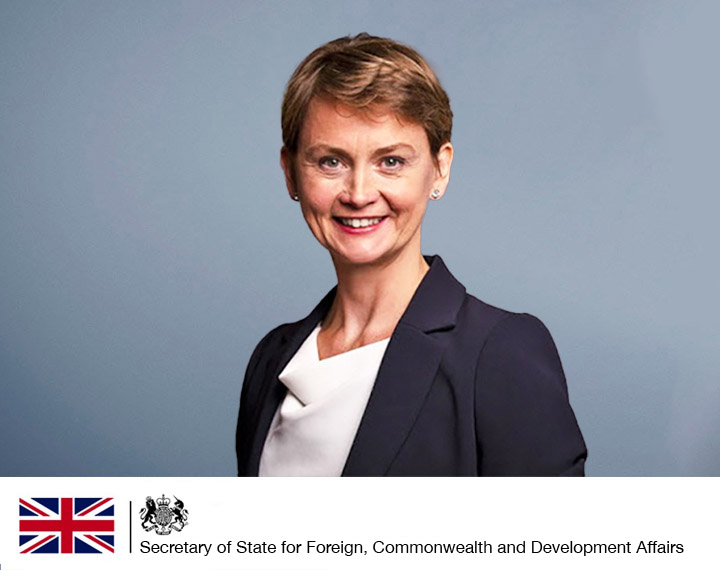
The Rt Hon Yvette Cooper was appointed Secretary of State for Foreign, Commonwealth and Development Affairs on 5 September 2025. She was previously Secretary of State for the Home Department from 5 July 2024 to 5 September 2025. She was elected as the MP for Pontefract, Castleford and Knottingley in July 2024.
Yvette Cooper’s political journey is a testament to perseverance, dedication, and a deep commitment to public service. Her story is an inspiring one, showcasing a remarkable rise through the ranks to become one of the most powerful and respected voices in British politics.
Born in Inverness, Scotland, and educated at Oxford, Harvard, and the London School of Economics, Cooper’s academic brilliance was a foundation for her career. She started as a journalist for the Financial Times and an economic researcher before entering politics. Her journey into Parliament began in 1997 when she was elected as the Member of Parliament for Normanton, following which she represented the constituency of Normanton, Pontefract and Castleford.
Throughout her career, Cooper has been a powerful force for change and progress. She has served in a number of prominent government roles, including Chief Secretary to the Treasury, and has been a passionate advocate for social justice, economic stability, and human rights. For much of her career, she has been a leading figure on the Labour front benches, serving as Shadow Home Secretary and a key contributor to the party’s policy-making. She is known for her forensic and meticulous questioning of government ministers, always holding power to account with intellect and integrity.
Her recent promotion to Foreign Secretary is a powerful and uplifting moment in her career. Stepping into one of the most demanding roles in government, she now represents the United Kingdom on the global stage. This appointment reflects her vast experience, her reputation as a skilled negotiator, and her deep understanding of international relations. Yvette Cooper’s leadership will now be instrumental in shaping the UK’s foreign policy, forging new alliances, and promoting diplomacy in a complex world. Her journey is a true inspiration, demonstrating that through hard work and a steadfast belief in one’s principles, it is possible to reach the highest echelons of public life and make a profound difference.
The United Kingdom’s First Secretary of State stands at the very heart of national leadership, embodying trust, authority, and steadfast responsibility. Appointed by the Prime Minister, the First Secretary of State is entrusted with supporting the direction of government at the highest level, often deputising in moments of national importance and ensuring the seamless coordination of policy across departments. It is a position that calls for experience, clarity of judgment, and an unwavering commitment to public service.
Beyond title and protocol, the office represents stability and unity within government — a guiding presence during times of opportunity and challenge alike. The First Secretary of State helps translate vision into action, strengthening collaboration across ministries and reinforcing the government’s collective mission. In fulfilling this role, its holder demonstrates not only political leadership, but also resilience, discretion, and a deep dedication to the wellbeing and prosperity of the nation.
The Foreign Secretary has overall responsibility for the work of the Foreign, Commonwealth & Development Office, with a particular focus on:
We pursue our national interests and project the UK as a force for good in the world. We promote the interests of British citizens, safeguard the UK’s security, defend our values, reduce poverty and tackle global challenges with our international partners. FCDO is a ministerial department, supported by 12 agencies and public bodies.
The Foreign, Commonwealth & Development Office (FCDO) of the United Kingdom is a governmental department with a rich history that spans centuries, evolving through various transformations and mergers. It is responsible for promoting British interests worldwide, developing international relationships, and providing support to British citizens overseas.
The FCDO’s origins can be traced back to the establishment of the Foreign Office in 1782, during the reign of King George III. This office was created to manage the United Kingdom’s foreign relations and diplomacy, reflecting the growing complexity and importance of international affairs in the 18th century. Throughout the 19th and early 20th centuries, the Foreign Office played a crucial role in shaping British foreign policy during significant historical events such as the Napoleonic Wars, the expansion of the British Empire, and both World Wars.
The Commonwealth Office’s roots date back to the post-World War II period when the British Empire transitioned into the Commonwealth of Nations. The Commonwealth Relations Office (CRO) was established in 1947 to manage relations with the newly independent states emerging from the former British colonies. This office aimed to foster cooperation and maintain strong ties within the Commonwealth framework, emphasizing mutual respect and shared values among member states.
In 1968, the Foreign Office and the Commonwealth Relations Office were merged to form the Foreign and Commonwealth Office (FCO). This merger streamlined the UK’s diplomatic efforts and better coordinated its international relations and development policies. The FCO became the principal institution responsible for managing the UK’s foreign policy, protecting British interests abroad, and promoting international peace and security.
In September 2020, the FCO merged with the Department for International Development (DFID) to create the Foreign, Commonwealth & Development Office (FCDO). This merger aimed to align the UK’s foreign policy and development goals, ensuring a more integrated and strategic approach to international relations and aid. The FCDO now focuses on addressing global challenges such as poverty, climate change, and conflict, while continuing to promote British values and interests worldwide.
The FCDO plays a vital role in shaping the UK’s foreign policy, managing diplomatic missions, and engaging in international negotiations. It is responsible for providing consular services to British citizens abroad, promoting trade and investment, and coordinating development assistance to support sustainable development in partner countries. The FCDO also works closely with international organizations, such as the United Nations and NATO, to address global issues and promote stability and prosperity.
The FCDO’s history reflects the evolving nature of the UK’s international relations and its commitment to fostering global cooperation and development. From its origins in the 18th century as the Foreign Office to its current form as the FCDO, the department has continuously adapted to meet the changing needs of a globalized world. Today, the FCDO remains a cornerstone of the UK’s efforts to promote peace, security, and prosperity on the international stage.



 Own or work here?