

The exhibition and shop are open daily April to October 10:00am to 5.00pm and Nov to March 10.00am to 4.00pm. Last entry to the exhibition is an hour before closing. Guided Walks take place every Saturday and Sunday at 1.30pm up to 27th March. Guided Walks will then take place on a Saturday, Sunday and Bank Holiday Monday at 11.30 am and 2.00pm. Pre-booking is advised but not essential for the Exhibition and the Guided Walks, please call 01455 290429 or book your ticket online. To find out safety measures in place for visitors returning to the exhibition visit our FAQs HERE.
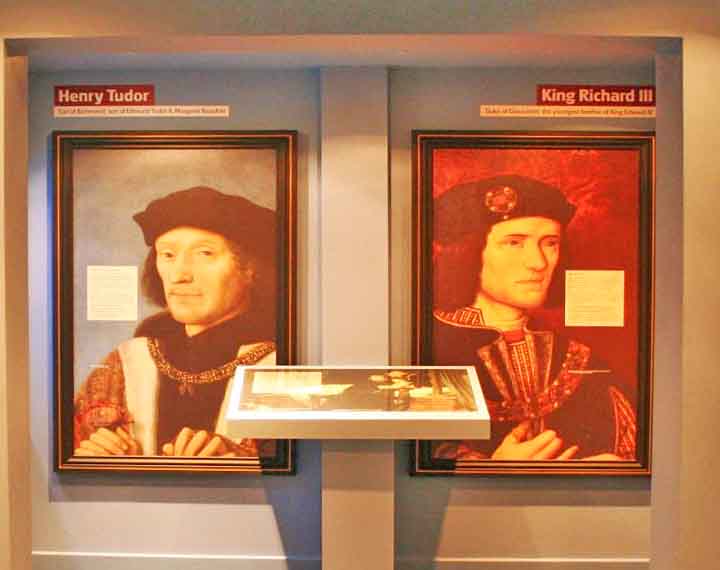
The 1485 Tithe Barn Café is open Wednesday to Sunday 10.00am to 4.00pm, providing a new menu. Seating available inside the Barn, booking advisable. For any enquiries please call 01455 291048. The Battle of Bosworth 1485: A rebel army wins the day. On the 22nd August 1485 Henry Tudor brought a small rebel army to face the much larger Royal army of King Richard lll. Writers of the time mention a marsh between the two armies. The Stanleys, whose loyalty to either side was as yet unknown, were positioned between the two armies, but to one side; probably to the South.
John de Vere, The Earl of Oxford was Henry’s military commander and he led the main army around the marsh and attacked King Richard’s right flank, commanded by the Duke of Norfolk. One writer describes heavy gunfire from the King’s artillery forcing this manoeuvre by Oxford’s men. Eventually, the Earl of Oxford defeated Norfolk’s army using a wedge formation attack and the Duke himself was killed, close to a windmill. Meanwhile, the Yorkist Earl of Northumberland, standing with a sizeable army supporting Richard’s left flank, did not move, possibly because of the marsh in front of him and the Stanleys on his flank.
With the battle not going his way, Richard saw Henry Tudor with only a small force of soldiers on the field. He rallied his mounted knights and led a mounted charge across the battlefield trying to kill Henry. At this point Sir William Stanley attacked, on Henry’s side. Richard was surrounded by his enemies, and lost his horse in the marsh. However, he fought on, vowing to win or die as the King of England. King Richard was cut down “in the thickest press of his foes”. Even his enemies describe him as dying like a valiant prince.
His crown was picked up and given to the Stanleys who unofficially crowned Henry Tudor as King Henry VII of England at Stoke Golding straight after the battle. Richard’s body was stripped of his armour and slung over a horse to be unceremoniously taken to Leicester for public display, to prove that he was dead, and later burial. Richard was the last Plantagenet King of England and Henry was the first of the powerful Tudor Dynasty, which changed the face of England for ever. Despite the national importance of this Battle, its exact location was never written down. This has led to much debate as to where the Battle took place.



 Own or work here?