

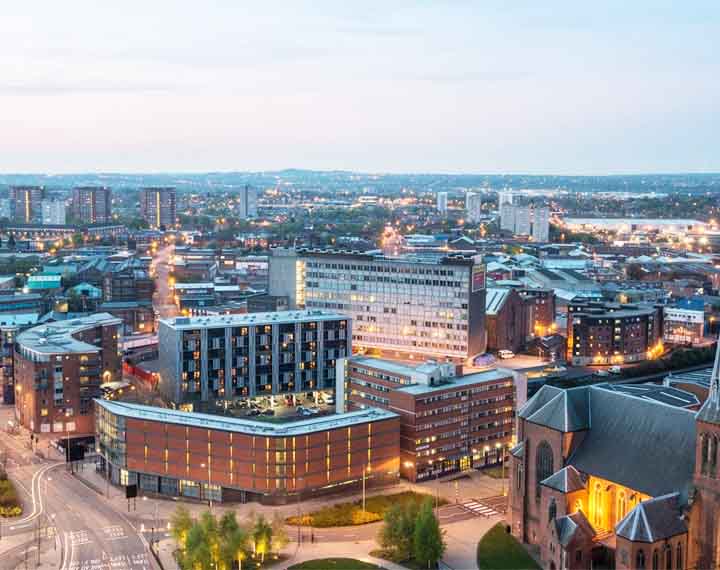
The Gun Quarter is a district of the city of Birmingham, England, which was for many years a centre of the world’s gun-manufacturing industry, specialising in the production of military firearms and sporting guns. It is an industrial area to the north of the city centre, bounded by Steelhouse Lane, Shadwell Street and Loveday Street. From the 16th century some of Birmingham’s many watermills were converted from corn grinding to industrial processes, not only in the town but also in the rural hinterland. By the 17th century many mills were used for sharpening agricultural blades and swords as this required little water and could be done on Birmingham’s small streams.
During the Civil War Porter’s Mill in Digbeth had single-handedly supplied fifteen thousand swords to the Parliamentary forces, with other mills adding to the number. Situated some twenty miles from a navigable river and built on a plateau, Birmingham is poorly placed for transport. However, the development of turnpikes and canals greatly improved the town’s ability to import raw materials and to export manufactured goods. By specialising in small products using a high degree of skill, enterprising manufacturers successfully branched out into producing a variety of small products, including swords and guns. Many local watermills were now turned to grinding or polishing gun barrels.
Manufacture of gun barrels at Birmingham using a steam hammer 1851
At the beginning of the 18th century there was a small concentration of gun makers in the industrial area of Digbeth. During the century, however, the trade gradually moved to the north-west fringe of the town largely on the Weaman estate around Whittall Street in the district now known as the Gun Quarter. This was conveniently situated near Kettle’s Steelhouses in Steelhouse Lane and close to the Birmingham & Fazeley Canal. Sketchley’s 1767 Directory of Birmingham lists 62 separate workshops involved in gunmaking.
In 1689 the Government entered into discussions with local gun makers and, after a trial order, in 1692 placed a contract with five manufacturers to supply 200 muskets per month for one year. This was the beginning of a massive expansion. During the war against the French from the 1690s until the Treaty of Utrecht in 1713, the industry was able to supply some forty thousand guns to the British government. By 1750 gunmakers Farmer & Galton were exporting to Africa alone twelve thousand guns a year.
In 1767 the town had thirty-five gun and pistol makers, eight gun barrel makers and filers, five gun barrel polishers and finishers, eleven gunlock makers, forgers and finishers, and three gun swivel and stock makers. Gun making was a very fragmented industry. The manufacture of the many parts of a gun was sub-contracted out to small independent workshops which specialised in specific aspects. Most gun barrels were not made in the Gun Quarter but brought in from Aston, Deritend, Smethwick and West Bromwich, and the locks were often made in the Black Country. Other parts were manufactured within the quarter, and the guns were generally, though not always, assembled here. In the late 19th century, Showell’s Dictionary listed more than fifty specialist trades involved in gun manufacture. During the Napoleonic wars 1803-1815 production reached unprecedented levels with over three million guns being made, and Birmingham’s gunmakers supplying two thirds of the guns used by the British army.
The Bull’s Head, Price Street
The Bull in Price Street dates from the 18th century, though the building has been extended and altered since. It is one of the small number of original buildings remaining in the Gun Quarter. During the 19th century it was usual for the gun workers’ to be paid their wages here.
Most gunsmiths set high standards of workmanship. Private proofhouses existed in Birmingham on gunmakers’ own premises and were available for use by others, but because proofing was not compulsory at that time, they were not used by less reputable manufacturers. Many saw the need for independent proof as was the case in London. As a result the Birmingham Proof House was set up by Act of Parliament in 1813 due to the lobbying of and at the expense of the Birmingham gun trade.
The Proof House, which is still very much in use, is not situated in the Gun Quarter but in Banbury Street, Digbeth. It still performs its original function and has a museum on site which may be visited by arrangement. It is a Grade II Listed building. There is a notable relief display of heraldry over three metres wide above the front entrance by William Hollins, which includes the Hanoverian coat-of-arms, the Birmingham shield with crossed swords, proof mark and a profusion of muskets, pistols, cannon balls, flags and drums. The present Jacobean-style gateway dates from 1883.



 Own or work here?